The Enneagram: Coping Mechanisms and the Development of Consciousness
“Psychology’s deficiency is the absence of essence
–A.H. Almaas Essence
in its understanding.”
In Part 3, we bring forward a basic outline of how the Enneagram interfaces with contemporary psychology. We emphasize a both/and approach to helping and healing: Western psychology and the development of consciousness. We can work on the symptoms of our suffering and address the root cause of suffering. This part is an outline of concepts and not intended to be comprehensive; instead, it intends to be objective and stimulate further objectivity to utilizing the development of consciousness in helping, healing, and human potential.
Modern psychology, born at the turn from the 19th to 20th Century, provides our mainstream approach to helping and healing. It offers numerous coping strategies across psychodynamic, cognitive-behavioral, and humanistic modalities and approaches.
The Enneagram can be thought of as a foundation for all psychology and a supplement to our mainstream approaches and practices. Today, licensed professionals require support of evidenced-based therapeutic approaches. Indeed, Google Scholar reveals thousands of evidence-based journal articles to support incorporating the Enneagram in helping and healing. Further, Part 2 of this article articulates the formal mathematical science behind the Enneagram patterns.
In brief, when we add the Enneagram to our repertoire of contemporary therapeutic modalities, we have a more objective lens to helping and healing, and to sustained change.
(1) A more objective lens to helping and healing which facilitates more rapid healing
- We have immediate access to understanding the 9 lenses in which clients view the world and 9 ways in which we suffer separation.
- We can understand that our helping lens of “figuring out life” through our Enneagram type is, in fact, our subjective lens and likely will not be as effective for clients with the other 8 types.
(2) Longer-lasting and more sustained change that incorporates the practice of developing our consciousness
- We can add essence and our recovery of essence to our understanding.
- We can add the development of consciousness to work alongside our repertoire of coping mechanisms.
- We can treat the symptoms of human suffering and the cause (our gap between me and not-me).
- We can understand integration within self, with the other, and with the environment or all of life.
To better understand bringing consciousness into the helping and healing profession, Part 3 is organized as follows:
| The first two sections will focus on definition of terms. • Ancient and Traditional Terms for Helping, Healing, and Curing • Original Enneagram Labels Used by Ichazo (1970) The second two sections will provide an orientation of bringing the development of consciousness into the helping and healing world. • The Enneagram: A Ground of Being for All Psychology • 3-Fold Orientation to Helping and Healing with the Enneagram The final four sections each highlight an objective concept in the development of a well-balanced personality and the development of our consciousness. • The Enneagram’s Holy Ideas • The Enneagram’s Harmony Triads • The Work and The 5As • The Enneagram’s 3 Octaves of Human Consciousness |
Ancient-Traditional Terms for Helping, Healing, and Curing
The knowledge carried forward through Gurdjieff and Ichazo indicates that our contemporary conceptualization of consciousness is a focus on what is called “ordinary consciousness.” We think we are conscious because: (1) we have memory and we think about the past, (2) we can also imagine and think about the future, and (3) we can, in the present, draw our attention to focus on a task appearing as our wilful action. However, ordinary consciousness, often called waking-sleep, misses the human capacity for controlled attention through an inner witness that observes our sensing, emotions, and thoughts while having them, then choosing which action to take at all times and everywhere.
In the helping process it’s important to discern these three types of attention: (1) mechanical or auto-pilot, (2) drawn, and (3) controlled.
Gurdjieff brought forward that what labels we use or how we define terms is the bedrock of common understanding or misunderstanding. If labels are not clear, understanding diminishes.
To better understand the Enneagram, we will now walk through terms, in several table-figures, rooted in ancient traditional psychology that are central to the understanding of the Objective Enneagram. Many of these terms will be familiar to those who have studied transpersonal psychology, indigenous psychology, traditional psychology, ancient psychology, or Eastern contemplative traditions. These labels are outlined in Figures 3.1 through 3.5.
Figure 3.1 The Problem: Personality The Solution: Essence
| The Problem — Personality •Personality is our unconscious coping mechanism to deal with separation, but ironically, through our habitual patterns and emotional reactivity our personality often hurts ourselves and others. •Conflict occurs when two realities of Personality (the inner desire) and outer environment don’t reconcile; the gap between inner state and outer world leads to the aversive emotions of anger, sadness, and anxiety. •Trauma occurs when two realities of inner and outer produce a seemingly irreconcilable gap between inner state and outer world. | The Solution — Essence •Essence is the unconditioned capacities we are born with before our childhood conditioning restricts or contracts our life to the environment we grow up in. •Development of consciousness from autopilot to wilful attention relaxes our personality structure and restores our essence. Potential for consciousness is 3-fold. We can: •develop a more balanced, healthy, and aware personality, •awaken and seek to know what is beyond personality, •realize our consciousness fully as objective and whole. |
“Psychological suffering is not the result of childhood conditioning, rather childhood conditioning leads to the loss of experiencing our essence.”
-A.H. Almaas Essence
Figure 3.2 Personality and Essence: A Deeper Dive
| Personality • The conditioned, limited false self experienced as separate from the all of the universe. • Consciousness or attention is mechanical and we are not present to it. • Unlike contemporary measurement of personality based on outside traits, the Enneagram of Personality is known from the inside out, including very precise and specific parts that make up the structure of personality. In the Enneagram of Personality, you will find: •Motivation: Natural instincts of survival, connecting with our species, and social-ecological adaptation to our environment •Defense Mechanism: A protective layer over essence •Sensorimotor Habitual Patterns: Sensing, moving, postures, expressions, pace •Emotional Habitual Patterns: Drive, reactivity, regulation strategies •Cognitive Habitual Patterns: Repeated narratives and preoccupations about how things work, solving problems, attempting to reconcile inner and outer •Instincts, Distorted or Bound by Conditioned Personality: Self-preservation, 1:1, Social | Essence • The unconditioned, free (or expanded) capacity to evolve with all of life. • Consciousness of attention is controlled or witnessed and we are present to it. • We are born with capacities that underlie all learned manifestations and are permanent and unchanging. • The experience of existence, presence, and union with the universe in which the gap between inner and outer dissolves. • Awareness of a living presence existing, and being: “I exist, and I am regardless of my upbringing, education, social standing, and conditioning.” • Physical examples of essence would include our capacity to taste vs. the conditioned preference for certain spices, the capacity to hear vs. conditioned preference for music genre. • Psychological examples of essence are revealed in the 9 Enneagram capacities of essence and the 3 instincts. (See Figure 3.3.) |
The essence capacities of the Enneagram are often seen in young children or people with evolved consciousness. Both essence and pure instinctual capacities naturally restore themselves with the relaxation of our personality structure.
Figure 3.3 Essence Capacities of the Enneagram: The Three Pure Instincts and the 9 Capacities to Receive Impressions Objectively
| Essence Capacities of Instincts Instinct for Survival of Our Species • Giving as able, receiving as needed Instinct to Connect with Our Species • Bringing presence of self to all relationships Instinct to Master Our Environment • Providing for the needs of the world sans manipulation and control | Essence Capacities of Unconditional Love of the Universe Itself Experiencing 8—Coming to the world with an open innocent mind 1—Seeing differences without assigning familial, cultural, or societal value 9—Inclusive love, love that we are all part of Allowing 2—Giving and receiving to naturally unfold 4—Connections to naturally arise 3—The universe to be the doer Knowing 5—Ample and objective knowledge is available 7—Possibilities emerge in a full spectrum and for a time and season 6—Without doubt that objective reality with capacities of essence exist |
Another set of traditional definitions includes the paradigm of distinguishing between coping and consciousness.
Coping is the tool we use to temporarily close the gap between me and not-me, between what I desire and what the environment delivers. Initially, our personality structure provides learned mechanical and habitual ways to cope, and through therapy we can release gaps of inner conflict or trauma and build a repertoire of new and effective coping strategies.
Consciousness can be developed so we have an observed state and experience of closing the gap between me and not-me, and has the potential to be sustained or realized, and manifests a more permanent shift in relieving the suffering of separation. Therapists can teach clients how to recognize mechanical attention and how to develop controlled attention. When presence and understanding emerge as part of the higher centers, the natural capacity of essence and the 3 instincts naturally are present.
With sustained attention or consciousness, people report that coping day to day or simply for self shifts to being present for others and the needs of the world. It’s as if essence is driving the car, and personality is in the back seat (our personality remains, but is no longer driving even as consciousness is realized.)
Figure 3.4 The Both/And in Helping and Healing: Coping and Consciousness
| Coping and Personality • Coping Strategies of Our Personality: These work until the next conflict, trauma, or gap between the desired or expected internal state and what the external world delivers forms another gap • Personality Lower Functioning: When our personality copes for self but cannot cope for others or for the world at large • Personality Higher Functioning: When our personality can cope for self and others | Consciousness and Essence • Developing Consciousness and Retrieving Essence: This extends to a lasting state which observes, exists, and is experienced as free, expansive, and joyful • Consciousness: Our attention • Spirituality: Higher levels of consciousness • God: The Evolution of the Universe • Attention: Can be, when not physically sleeping, mechanical, drawn, controlled, or objective. • Inner Witness: Awareness of our awareness develops the controlled attention of watching our thoughts and emotions while having them • Personality and Essence: When personality relaxes, takes the back-seat, and is no longer running the show, our essence is available for us, we, and our needs as well as the needs of the universe. Personality is not to be removed; it can be enlightened |
When using the Enneagram of Personality in the helping and healing profession, you will also come across the terms balance or balanced personality and integration. (Figure 3.5.) The indigenous or traditional definitions of these labels offer a fresh perspective for our current times.
Figure 3.5 Definitions of Balance and Integration Based on Traditional or Indigenous Healing
| Balance: When all 3 centers are working evenly, doing their own work, and doing it in alignment with its evolutionary purpose. Can also be seen as inner harmony. Instinctual-Moving — Receives the world through our senses and movement Emotional — Asserts self through our emotions and consideration of self Intellectual — Attempts to reconcile the gap between environment and internal state from past experience Using Consciousness to Achieve Balance: In addition to practicing using all 3 centers simultaneously, practice: (1) leaning into unfamiliar and/or oppositional healthy patterns of other types (e.g. practice receptivity, if you are an assertive type), (2) inner witness or controlled attention, and (3) transforming stress by seeing its origin within us. | Integration: An inner experience of wholeness with self, others, and ultimately our environment/the world (inner state aligns harmoniously with outer). Can also be seen as inner and outer harmony. Through the practice of open-hearted presence, recognition, and receptivity of our differentiated, vital and/or under-used capacities, integration works as a transformer of human life. In the Enneagram, integration focuses on the 9 Holy Ideas as well as the proper use (in context) of our 3 centers of intelligence, our 3 energies, our 3 forms of emotional regulation, and our 3 instincts. Using Consciousness to Achieve Integration: In addition to practices to balance the centers, practice: (1) observing self in action and becoming free of its mechanical habits, (2) considering the real needs of others—not just your or their desires, and (3) being in the moment rather than revisiting the past or preparing the future, that is, practicing a constant “I am” and I exist now. |
Original Enneagram Labels (1970)Used by Ichazo
As this project’s overarching goal is to preserve the objective knowledge of the Enneagram, this section will document the original labels Ichazo used in his training in 1970 in Arica, Chile. The first reference to the Arica training in English to North Americans that we could locate is from interviews with Ichazo by Sam Keen, published in Psychology Today in 1973 as “Breaking the Tyranny of the Ego.”
In Figure 3.6, you will see that he used one- or two-word descriptions for the 9 pattern labels that include a precise, deep, and specific structure of how the fixation of each pattern works. Many books and websites have used contemporary labels, but the protection of essence or the defense structure of the personality remains the same despite the label. However, as time goes on, Ichazo’s labels are undergoing change and possible subjective distortion, so documenting them for future generations is critical.
The original labels we refer to in the Enneagram of Personality, the Enneagram of Process, and the Objective Enneagram came from Ichazo and Gurdjieff, respectively. Ichazo’s terms are influenced by his time and place in South America in the 1950s to the 1970s, having studied the Western Prophetic Tradition that arose from Egypt.
Gurdjieff’s terms are influenced by his Greek-Armenian upbringing close to the rural Caucasus mountains during the 1870 to 1890s.
In respect to Ichazo, he presented the 9 types or patterns as fixations of subjective consciousness and remained highly concerned throughout his life that the Enneagram or enneagon had become a personality self-help system, rather than used for their core purpose to awaken and transcend the distorted fixations.
It was Naranjo who brought the Enneagram to Berkeley, California in 1970, using the language of personality. This was in alignment with Gurdjieff’s discernment of:
- Essence — our biological, expansive capacities serving all of life
- Personality — our learned, restricted state, serving self
Figure 3.6 is central to the Enneagram of Personality. Holy is the old English word for whole, and the word idea originates from the Greek word referring to a pattern with nothing underneath. Our essence reflects each of these capacities, whereas the nine personality types become a compensation, inversion, or a mimicking serving to protect the respective 9 capacities. Thus,the 9 Holy Ideas are the ultimate remedy or psycho-catalyzers relieving the suffering of separation.
As the Holy Ideas are key to integration of inner and outer harmony, they also bring us the higher centers of function for the essence. The higher mental and emotional centers communicate purpose and reason, replacing the subjective and accidental conditioning that we have each received.
For example, Type 3’s fixation is Vanity-Go, that “I am the doer” and their capacity is Holy Hope that “the universe is the doer.” A psychological integration of sustaining an embodied experience that the universe is the doer, substantially softens the reactivity of the personality to do. The other 8 types have a similar psycho-catelyzer.
Along with the Holy Ideas are the Emotional Virtues and corresponding lower emotional center Passions or emotional drivers. (See Figure 3.7.).
Figure 3.6 Ichazo’s Original Labels: Holy Ideas and Ego Fixation
| Holy Ideas: Held in the Essence, these are capacities of essence to receive objective knowledge | Ego Fixations: Held in the personality compensation, these reflect operating on autopilot in the Lower Intellectual Center |
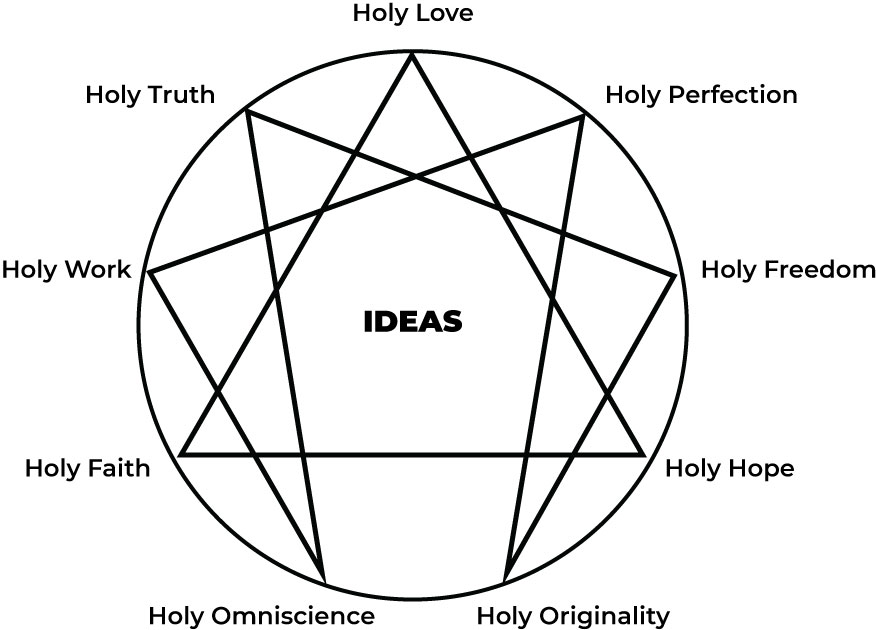 | 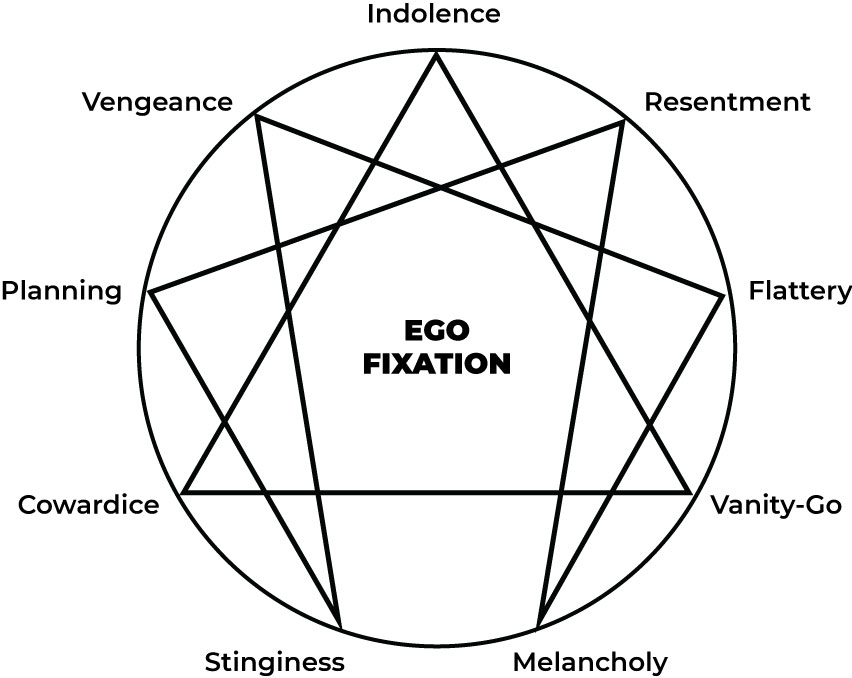 |
| Legend 3.6 In later writings, Ichazo changed “Holy Originality” at Point 4 to Holy Origin” and “Holy Work” at Point 7 to “Holy Wisdom.” |
Figure 3.7 Ichazo Original Labels: Virtues and Emotional Passions
| Virtues: Held in the essence, these are emotional states that emerge in the Higher Emotional Center | Emotional Passions: Held in the personality compensation, these are drivers that activate on autopilot in the Lower Emotional Center |
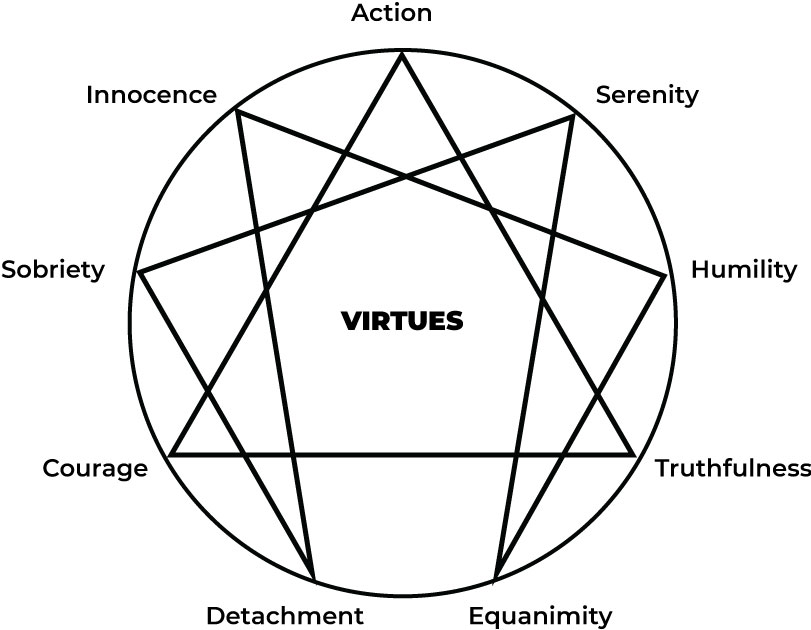 | 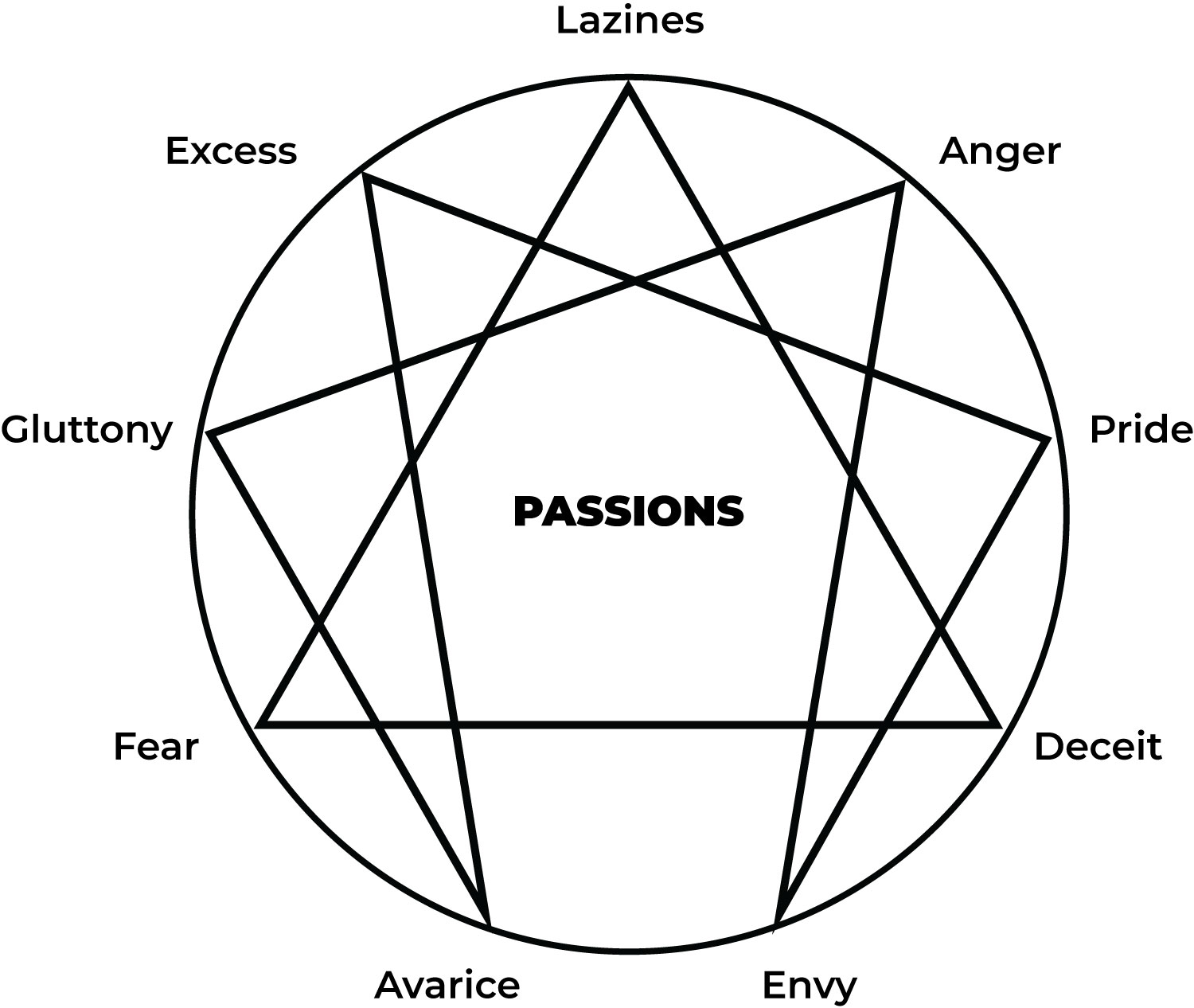 |
The earliest labeling of Ichazo’s distorted instincts (Figure 3.8) found in North America come from the 1975 publication of Transpersonal Psychologies, The Arica Training, Lilly and Hart.
Figure 3.8: Ichazo Original Labels: The Conservation, Relation, and Adaptation Instincts
| From Cosmology of the Law of 3 and 7: All of life seeks to survive, all instincts initiate | Instincts Distorted by Conditioned Personality |
|---|---|
| Pure: All of life seeks to survive and thrive. Distorted Pictured: Conservation | 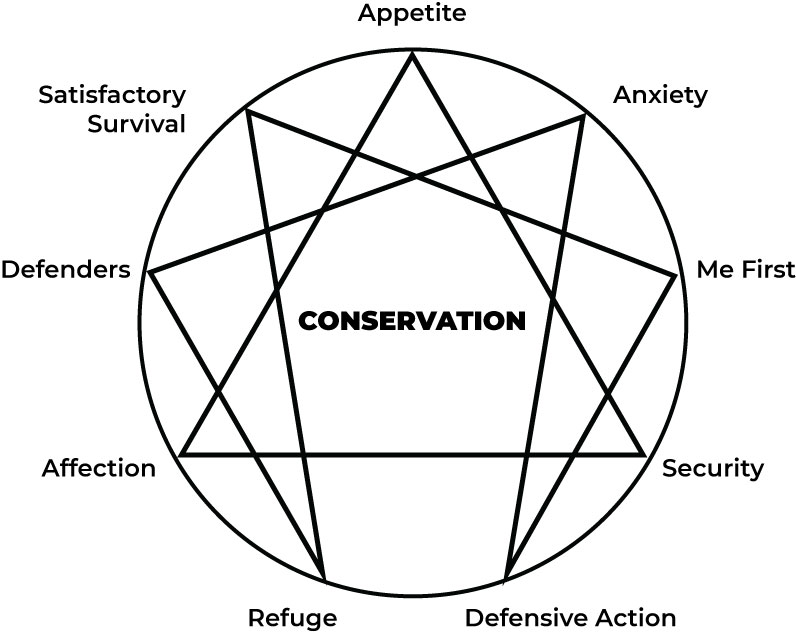 |
| Pure: All of life seeks to connect with its own species. Distorted Pictured: Syntony/Relation | 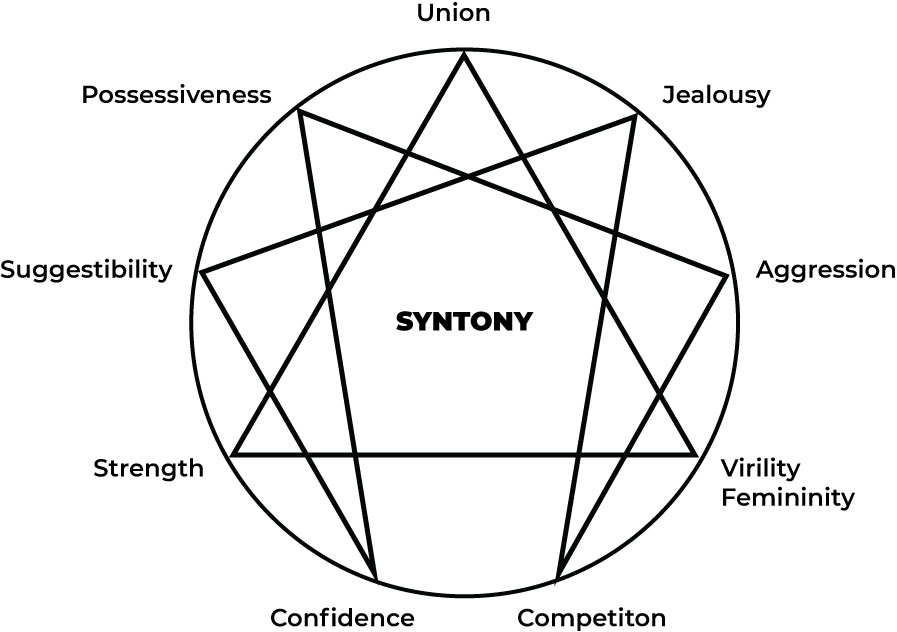 |
| Pure: All of life seeks to master the world (to make it more amenable). Distorted Pictured: Social/Adaptation (Note: Later Ichazo writings used Adaptation to the Whole of the Environment, not just the Social Environment.) | 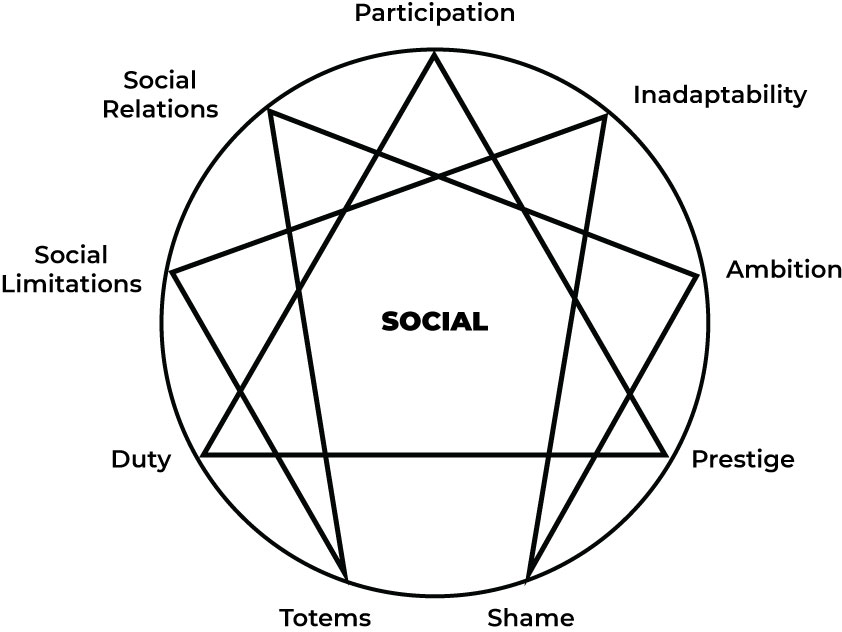 |
The Enneagram: A Ground of Being for All Psychology
One of the first things that therapists and other professional helpers realize when they learn the Enneagram is that they themselves have been seeing the world subjectively through one of the nine Enneagram points. Psychiatrist Claudio Naranjo who studied and treated psychopathology was the first to call the nine patterns the Enneagram of Personality.
Once you get to know the system deeply, you can see that it is a system of distorted, subjective, or limited consciousness. It is important to reiterate that doing The Work to shift our consciousness restores who we really are, our innate essence.
In addition, the Enneagram rapidly points out that all psychological theories and treatments have both a bias in one of the 3 centers and, very often, one of the 9 types. The good news is that the Enneagram provides a ground of being for all psychology.
In psychology and counseling’s major modalities, all approaches have found their home in the Enneagram:
Depth and Psychodynamic Psychology
- Facilitates the awakening of our mechanical and unconscious habits
- We discover that the id, ego, and superego are all on autopilot (not just the id)
- Reveals 9 psychodynamic patterns and 9 core defense mechanisms
- Also, even finer defense mechanisms in the 27 types
- Helps discern our 3-fold object-relations conditioned patterns
- Withdrawing, asserting, and complying
Cognitive and Behavioral Psychology
- Facilitates awareness of awareness of our thought patterns and how to adhere to witnessing and changing our thought patterns, cognitive narratives, and habituated behavioral responses
- Helps us discern when our attention is:
- Mechanical attention (autopilot thinking, reviewing, anticipating, etc.)
- Drawn attention (mindfulness or mindsight)
- Controlled attention (willful attention becomes possible with committed daily practice)
Humanistic, Whole Person, and Whole Systems Psychology
- Facilitates an awareness of our motivations, attention styles, cognitive, emotional, and somatic patterns
- Inclusive of early attachment and interpersonal neurobiology, revealing 3 patterns of healthy and unhealthy attachment
- Inclusive of both temperament and attachment, family systems
- Encourages unconditional positive regard and non-judgemental receptivity of others
Traditional, Indigenous, Existential, Transpersonal Psychology (often categorized under Humanistic)
- Facilitates awareness of awareness
- Reveals answering life’s deeper questions of meaning and purpose, as well as death, freedom and free will, and isolation
- Facilitates going beyond personality
- Offers self-verifiable practices to cure the suffering of separation, from mindfulness and meditation (drawn attention) to daily use of witness consciousness (controlled attention) to disrupt the mechanical personality structure that works on autopilot without controlled attention
3-Fold Orientation to Helping and Healing with the Enneagram
Again, in the spirit of a brief summary, there are three concepts that help us orient to using the Enneagram in helping, healing and human potential:
- Identity: Identity of Consciousness
- Not the usual identity of who you are in society but one of 3 identities of consciousness (described in Figure 3.9)
- Content: Intellectual Understanding of Why the Enneagram Works
- One should be able to explain how and why the Enneagram helps; it is not “guess-work”
- Process: Therapeutic and Self-Help Practices and Embodied Experience
- Process goes beyond intellectual content to experiencing your own embodied verification in which a therapist or teacher has internally verified for him or herself before teaching, helping, and attempting healing of others
Identity of Consciousness
In considering approaches to helping and healing, Gurdjieff offers a valuable insight on Identity within the context of developing consciousness (see Figure 3.9). You can notice where your identity belongs—column A, B, or C?
Figure 3.9 Big Picture Perspective on Identity within the Context of Developing Consciousness
| A Identity and Influences | B Identity and Influences: | C Identity and Influences |
|---|---|---|
| Identity: Become a balanced, healthy, good-person personality. | Identity: Become a seeker of what is real, what is objective, what is beyond personality? | Identity: Become highly motivated to develop the higher emotional center, impartiality, non-dual thinking. Followed by development of the Higher Mental Center, replacing opinion and belief with objective reasoning. |
| Influences are from the ordinary life of humans. The Enneagram of Personality is used as an intellectual tool. | Influences are from transpersonal, esoteric, and indigenous (meaning sacred or objective understanding). The Enneagram of Personality reveals awakened experience but can revert to being used as a subjective intellectual tool. | Influences are from objective knowledge, a master, a realized being with objective consciousness. The Enneagram of Personality is used with objective practices and commitment is firmly in place. |
| Personality becomes a more effective coping mechanism. And with external shock of life beyond personality… one can… Go beyond to ask what is beyond personality. How can I find information that extends to truly relieving suffering of self and others? | Personality softened, the physical, emotional, and intellectual centers are balanced, coping extends beyond self, integration of self and environment experienced. And with external shock of living in subjective reality… one can… Go beyond to find objective truth; faith becomes not blind. Commitment to do the work, to experience life beyond personality. | Personality is in the back seat, essence is driving, consciousness is available for self, other, and the world, integration of self and the environment sustained for long periods. And with external shock of experience a crystallized higher emotional center… one can… Develop the higher mental center, capacity of objective reasoning from the laws of the universe itself. Unity consciousness. |
Intellectual Understanding of Why the Enneagram Works
Claudio Naranjo, M.D. was a psychiatrist. As a result, when he introduced the Enneagram of Personality to North America in 1971, he focused on understanding psychopathology and how we could become healthy. He viewed psychopathology as characterological rather than a diagnosis of the person.
Naturally and consequently, the Enneagram of Personality has generally been focused on identity as described in column A of Figure 3.9 above. That is, identity is the development of a whole, healthy, well-balanced, good-person personality. However, many early students as well as many at this time are highly interested in identity as described in columns B and C—seeking beyond personality; and realization of consciousness that is sustained.
What the Enneagram of 3 types of centers, 9 types of personality, and 27 instinctual subtypes distorted by personality shows us is that there is a great range in which the 9 ego fixations or chief features manifest. We who have a loving and caring family of origin where we experienced secure attachment tend to have a milder fixation (or obsession). But we who have had a confusing, abusive, or traumatic childhood have a more fixated personality.
But what is true for all of us is that the Enneagram reveals all that we don’t see. It provides rapid understanding of self and others, and in doing so, provides a de-shaming and acceptance of what is. We see our mechanical unconscious nature and it then provides freedom to not act from our conditioned personality.
A psychotherapist who gets to know the Enneagram will inescapably contemplate
— Claudio Naranjo, M.D. Enneatype Structures
the therapeutic process as one of going against the stream of the nine chief features.
Indeed, personality represents the limited—sometimes called distorted—lens on reality. What we do not see is in opposition to what we do see.
Skilled therapists who understand the entire system of the Enneagram—the 3 centers, the 3 forces, the 9 Holy Ideas, the 9 mental fixations, the 9 emotional virtues, the 9 emotional passions, the 9 defense mechanisms, and the 3 pure and distorted instincts with the resulting 27 subtypes—will be able to integrate what is in opposition, hold what is, relax the defense system, and restore essence.
Beginning in 1984, David N. Daniels, M.D., also a psychiatrist, devoted his life to understanding and using the Enneagram for health, well-being, as well as for loving and living better.
Daniels developed the concept of the Basic Proposition for reclaiming our lost Holy Idea or our lost capacity of essence. In fact, Ichazo introduced the Holy Idea as the primary remedy or psycho-catalyzer of the fixation. Integration of the inner and outer world also brings higher centers of function for the essence. These centers communicate purpose and reason, replacing the subjective and accidental conditioning that we have each received.
“The higher quality of our original essence that goes into the background
-– David Daniels, M.D. The Enneagram, Relationships, and Intimacy
and what we come to believe instead is the foundation of our Enneagram type structure.
This set of core beliefs govern each type’s existence about survival,
an agreement with self that dictates what it must and must not be in order to be loved and accepted.’’
In Daniels’ work, he introduced many valuable concepts for helping, healing, thriving, and developing our consciousness. He often mentioned we could go beyond western psychology’s focus on coping mechanisms by adding the curative potential of consciousness.
Next, we will outline four concepts using the curative potential of developing consciousness in helping and healing with a brief summary of how they work.
- The Enneagram’s Holy Ideas and Restoration of Essence
- Stemming from the Holy Idea, its embodied integration is the key to our development and restoring our essence.
- This works because the Holy Idea is the remedy for which the personality structure compensates. An embodied integration of the Holy Idea can be verified in your own experience, often as a fundamental shift in freedom from one’s ego.
- Stemming from the Holy Idea, its embodied integration is the key to our development and restoring our essence.
- The Enneagram’s Harmony Triads in Balancing and Integrating
- Stemming from the core triads of gaining and offering value in our personality (8, 2, 5; 1, 4, 7; 9, 3, 6), its balancing is key because it contains all 3 centers and dynamics of the other triads.
- This works because all 3 centers can be balanced, and we can move to integration where we consciously, simultaneously use all 3 centers, freeing energy and relaxing the personality. Both balance and integration of the centers can be verified in your own embodied experience.
- Stemming from the core triads of gaining and offering value in our personality (8, 2, 5; 1, 4, 7; 9, 3, 6), its balancing is key because it contains all 3 centers and dynamics of the other triads.
- The Work and the 5As—Awareness, Acceptance, Appreciation, Action, and Adherence (also known as the Universal Growth Process found in all contemplative traditions)
- Stemming from the practice of disrupting the mechanical personality, the daily commitment of the 5As relaxes the personality structure allowing our natural instincts, essence, and higher capacities to emerge. This is the work that Gurdjieff referred to as the relentless ongoing practice of bringing yourself back to the present moment always and everywhere. The mechanical mind will take off without your permission, and the witness consciousness in the 5As brings us back again and again. These 5As are objectively found in all contemplative traditions and David Daniels acknowledged them the Universal Growth Process. He said it was a daily commitment, smiled and said a lot more than 50 times a day.
- This works because personality moves to the back seat. We can verify in ourselves that essence is leading in which we are in presence to what is. We can recognize a shifting from me/my/mine to we/us/ours, and our distorted instincts become more natural and free again.
- Stemming from the practice of disrupting the mechanical personality, the daily commitment of the 5As relaxes the personality structure allowing our natural instincts, essence, and higher capacities to emerge. This is the work that Gurdjieff referred to as the relentless ongoing practice of bringing yourself back to the present moment always and everywhere. The mechanical mind will take off without your permission, and the witness consciousness in the 5As brings us back again and again. These 5As are objectively found in all contemplative traditions and David Daniels acknowledged them the Universal Growth Process. He said it was a daily commitment, smiled and said a lot more than 50 times a day.
- The 3 Octaves of Human Consciousness
- In the three octaves of human consciousness you can observe the 3 identities of consciousness. Octave 1 includes a well-balanced personality, Octave 2 includes seeking beyond personality, and Octave 3 includes a full commitment to doing The Work which can realize consciousness.
- This works because the 3 octaves reveal the evolution of consciousness that can be realized by anyone. Moving through the 3 octaves and getting past the denying force includes great motivation. As we will explain, you can yourself verify each of the 7 inner principles of each of the octaves.
- In the three octaves of human consciousness you can observe the 3 identities of consciousness. Octave 1 includes a well-balanced personality, Octave 2 includes seeking beyond personality, and Octave 3 includes a full commitment to doing The Work which can realize consciousness.
Therapeutic and Self-Help Practices and Embodied Understanding
In the following four sections we will provide extremely brief outlines of process and practices that we can bring to helping and healing. As we go through a healing process, many professionals know that motivation, if not great motivation to grow and change is necessary.
“What we practice starts to become familiar, less uncomfortable,
— David Daniels, M.D.
and more feasible with every try.”
Dr. David Daniels was a big advocate of practice. He was aware that the process lets us take ourselves on, to struggle with our material and our autopilot nature. He believed that contemporary self-help over-emphasized the intellectual education on the cognitive study of theory. He taught that we need to know both content (intellectual understanding) and process (work and practice, work and practice to heighten your consciousness).
Practice with The 5As or Universal Growth Process of healing and helping must include the intellect of why things work the way they do, but also an internal verified experience. Together, intellect and experience build understanding. Actual change requires the implementation of repeated, practiced experiences—everywhere, often, and (eventually) at all times.
The Enneagram’s Holy Ideas and Restoration of Essence
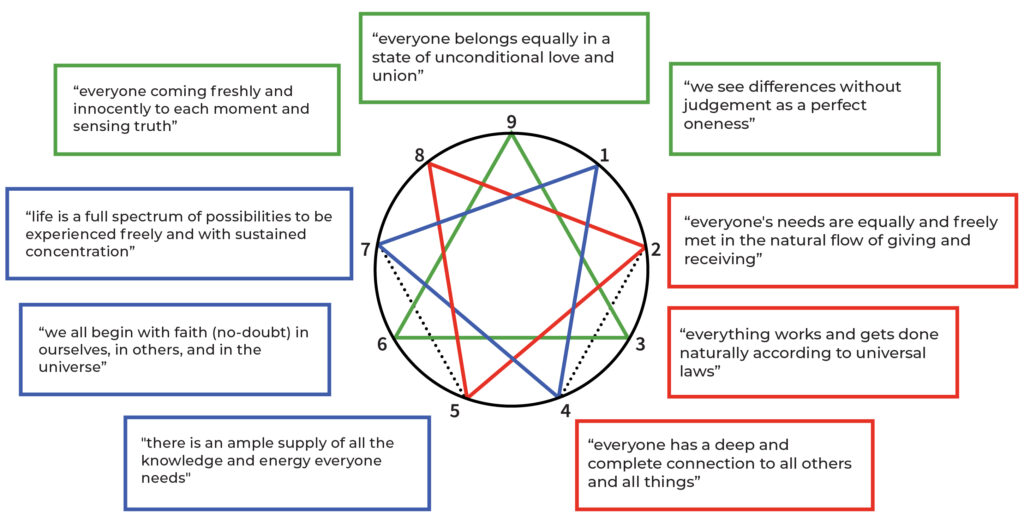
The nine Holy Ideas or patterns of wholeness are described through the lens of the essential quality that personality protects. (See Figure 3.9.) This essential quality or capacity of essence goes into the background or what Daniels described as “the child loses sight of the essential capacities of essence.” Because this essential state is in the background of the conditioned personality and is the starting place for the structure of personality, it is the key remedy—what Ichazo called the psycho-catalyzer or ultimate remedy.
Daniels defined the personality structure of each type as the Basic Proposition that becomes the key to integration. This Basic Proposition stems both from the Holy Idea and that the embodied recognition and integration of this essential quality the child lost sight of could be restored. We are not aware of any Enneagram teachers who would disagree that the integration of the Holy Idea is the key remedy for relaxing the personality structure, restoring essence, and achieving integration between self and the environment.
Elements of the Basic Propositions
These elements mostly operate in the background, unconsciously:
- The aspect of the original essential state (embedded in the 9 Holy Ideas)
- Given the child’s perceptual filters, the experience that led to the loss of the essential quality and to personality formation
- What the child comes to believe instead—the compensating goal and associated adaptive strategy for survival and satisfaction
- The concurrent development of the emotional passion interwoven with where attention naturally goes
- The defense mechanism or glue that supports this structure
- The worst fear or concern that must be avoided
- What this costs in relationships and in manifesting our higher essential quality or virtue
The Basic Proposition of which the absence of the Holy Idea is the umbrella of the personality structure thus determines our dominant mechanical patterns of thinking, feeling, and sensing. All nine capacities of essence are shown in Figure 3.10. You may relate to them recalling glimpses in your childhood or glimpses in young children and higher order mammals. (Additional information on working with the Basic Proposition is included in Sources, Resources, and References in About on this website.) The main point being that integrating our lost capacity of essence naturally denies the personality that functions for I/me/mine.
As you closely examine the 9 capacities of essence in Figure 3.10, it becomes clear why integration and harmony between inner and outer are possible. Each essence capacity allows us to receive reality as it is, allowing the universe rather than the personality to operate.
Figure 3.10 The 9 Capacities of Essence that We Lose Sight of as the Conditioned Personality Grows
The Enneagram’s Harmony Triads
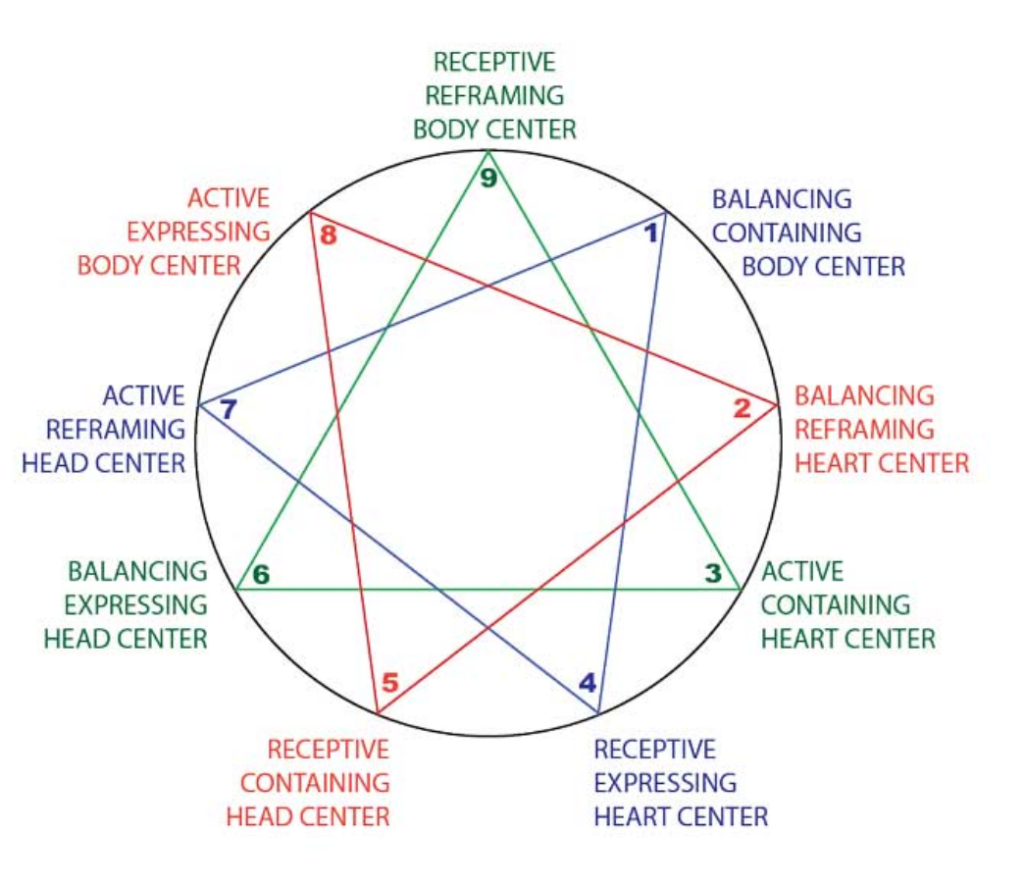
The Harmony Triads, introduced in Part 2, bring clear focus to how we balance and integrate our centers. Figure 3.11 presents a visual of the Harmony Triads represented by the three triangles of green, blue, and red. The other three triads are shown in words. For more information on using the Harmony Triads in practice, see the Harmony Triads by Dr. David Daniels.
Each of the 9 types can both balance and integrate through daily practice of the 5As (see next section). Through our conscious controlled attention we can what Ichazo called neutralize our fixation.
- The 3 Key Functions of the Centers
- Receives the environment through senses and movement to close the gap of separation moves to experiencing what is
- Asserts self through emotion and connection to close the gap of separation moves to allowing connections to naturally unfold
- Attempts to reconcile and close the gap between the environment (external) and feelings (internal) moves to understanding—both intellectual knowledge and the knowledge of the embodied experience
- The 3 Emotional Regulation Triads
- Shifting emotions without completely repressing them
- Down-regulating emotions so they are contained and present rather than suppressed
- Up-regulating emotions enough for constructive expression and verbalization to uncover what’s really going on and increase knowledge
- The 3 Energy Movement Regulation Triads
- Receptive and present energy without withdrawing
- Active and grounded energy without aggressive forcing
- Balanced energy that takes in the self and the other without complying to others
Figure 3.11: The Harmony Triads
The Work and The 5As
The 5As—awareness, acceptance, appreciation, action, and adherence—are simple ways to remember the Universal Growth Process (or Practices) found in ancient and contemporary contemplative traditions around the world. Whether it is Buddhism, Taoism, Zen, Sufism, mystical Christianity, Judaism, Hinduism, or Sikhism, various forms of the 5As appear as practices to dissolve the ego and restore our essence. Gurdjieff simply called it doing The Work. And The Work starts the minute you wake up in the morning and ends when you go to sleep.
Systems like the Fourth Way have a very different objective. They seek to refocus attention on the interface between essence and the world.This de-emphasizes the autopilot responses of learned conditioning and replaces those responses with conscious choice informed by external considering. Personality is not to be removed, but it can be enlightened.
- Awareness is a form of recognition; it’s the state of becoming present and cognizant. We are not talking about ordinary awareness of a past, present, and future. Rather, it is awareness of awareness. It is conscious and it is deliberate. It is the watching of information and energy within us. Awareness is neutral. It has no opinion and has no preference; it simply observes.
- Awareness is awareness of our awareness or using our inner witness to watch our consciousness throughout the day. It is pausing for specific practices such as a fundamental breath, conscious walking, or presence practice which also raises our awareness of awareness—also known as controlled attention.
- Acceptance is allowing without being judgmental, without censoring, without sedating.
- Acceptance is opening the heart in kindness to self and others, but especially to our own reactivity and upset. This doesn’t mean capitulating, condoning, or agreeing with our own or others’ behavior. It simply gives a positive way to acknowledge, learn, and work with our reactivity.
- Appreciation is a feel-good sensation that comes from recognizing what is good and positive in ourselves, in others, and in the world. Appreciation lets us take in the gifts present in all things—even in what may feel challenging, disconnecting, or daunting.
- Appreciation requires realizing that the positives in our lives often get neglected and require our re-experiencing them in order to help us use appreciation as a great resource.
- Action is action. Awareness without action is not awareness at all. What is the point of recognizing something, becoming aware of a pattern that’s gripped us, perhaps one that’s inhibiting our self-expression, damaging our connection to others, or hurting us and doing nothing about it?
- Action is mentoring ourselves into conscious action that’s either letting go or taking action that’s respectful to self and considerate of others.
- Adherence is commitment. It’s the agreement with ourselves to practice this process every day. This is a commitment to self-discipline. We can evolve our consciousness knowing that it takes work, which is possible in each moment.
- Adherence is committing to the 5 A’s and to working with type-related core issues in daily life, realizing that changing our patterns takes continual practice. When we can witness or observe our own habits of mind in a nonjudgmental, grateful way and notice the repetitive, limiting patterns by using the first 3 A’s—awareness, acceptance, and appreciation—we gain great leverage in changing the pattern and restoring our essence.
Using this knowledge and these practices—that is, doing the work by going beyond simply absorbing intellectual understanding—we can develop a healthy, well-balanced personality in which a relaxing of our personality can be verified by those close to us, and most importantly, by ourselves. We can also use the 5As to go further. At first adherence might be experienced as a chore, but the ongoing action of practice brings us a companion of our own consciousness and can be experienced as no separation, pure delight, or even an exalted feeling state.
(There are also other resources to aid in this journey, included in Sources, Resources, and References in About at the end of this article.
The Enneagram’s 3 Octaves of Human Consciousness
To conclude this series, we present the big picture of the work Gurdjieff brought forward from Eastern science on developing our consciousness: how the Diatonic Octave informs 3 octaves, each with 7 objective inner principles.
Octave 1: The evolution of a healthy, balanced personality
Octave 2: The evolution of seeking what is beyond personality
Octave 3: The evolution of higher consciousness
The Eastern science of the Vedas is also consistent in that the 3 octaves reflect the Gunas. The first octave begins with Tamas, or ignorance, as we are in the mechanical, auto-pilot personality. The second octave begins with Rajas, or passion where we may start to question what is beyond personality bringing drawn attention to witness ourselves. The third octave Sattva, or harmony represents a conscious, controlled state.
Thinking back to the identity of consciousness (Figure 3.9), we now present how the movement of the 3 Diatonic Octaves reveal the development of consciousness from a healthy, balanced personality to seeking beyond personality to realization of higher consciousness (that is, Identity A to B to C).
In the Diatonic Octave, there are 3 octaves, each having 7 objective inner principles, and each able to reach completion if they can pass the denying force:
- Octave 1 (gray): How we develop from a healthy, balanced personality to seeking beyond personality,
- then, with the possibility of an external shock, the transition to unconditional hope (or non-attachment to outcomes)
- Octave 2 (blue): How we develop from seeking beyond personality to the rise of a sustained magnetic force within us to find and experience knowledge that is truly objective,
- then, with the possibility of an external shock, the shift to unconditional faith (or knowing objective knowledge)
- Octave 3 (green): how we develop from a sustained magnetic force to a “fourth-way human” who has crystallized the use of all 3 centers,
- then, with the possibility of an external shock, the shift to the higher emotional center, the rare possibility of the higher mental center, and the most rare realization of unity consciousness.
These moving octaves are presented in Figures 3.12 and 3.13.
Figure 3.12: The 9 Points in the Traditional Enneagram Diagram Reveal 3 Octaves
| The line of the flow of forces or blending, the division of a whole into nine aspects is as ancient as the Enneagram itself: The lower gray octave has 7 lines and 2 shocks (red) The higher green octave has seven lines and 2 shocks (blue) The nine points in the traditional Enneagram Diagram reveal 3 octaves: • Gray: Healthy, balanced personality • Blue: Seeking beyond personality • Green: Realization of higher consciousness The Law of 3 also defines a flow of blending in which the higher blends with the lower to actualize the middle. | 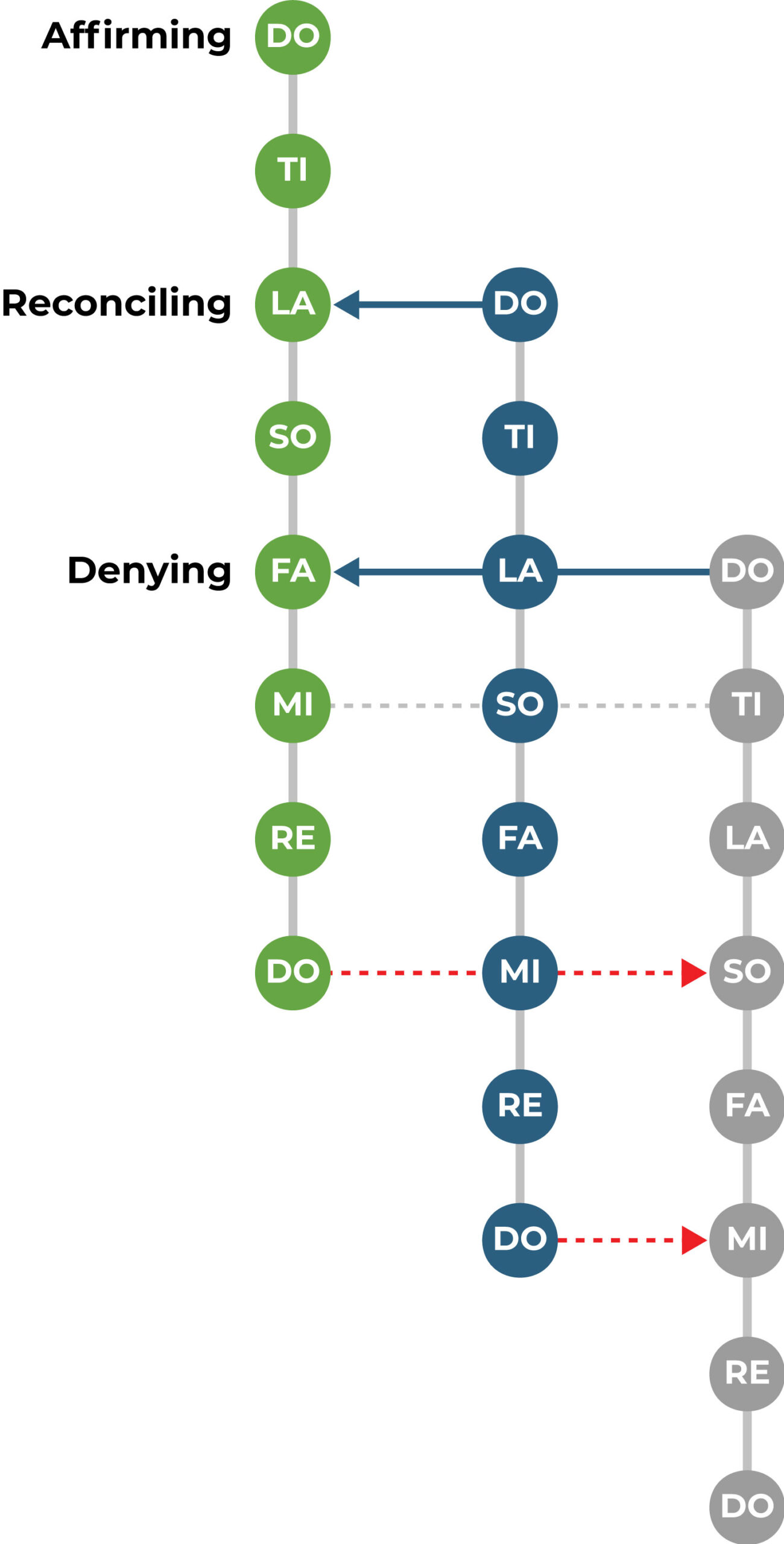 |
In Gurdjieff’s Fourth Way system, hydrogens represent a scale of matter (energies) classified by their density, vibration rate, and the number of laws acting upon them. As consciousness develops, the hydrogen numbers become lower (e.g., from 768 down to 12 or 6) because lower numbers signify a decrease in density, an increase in vibrational frequency (finer matter), and a decrease in the number of laws governing the energy. In figure 3.13, we represent the first octave and you will note a decrease in density of hydrogen from 768 to 192 to 48.
Figure 3.13 The Traditional Enneagram with a Division into 9 Reveals the Dynamic, Living, Moving Symbol of Consciousness.
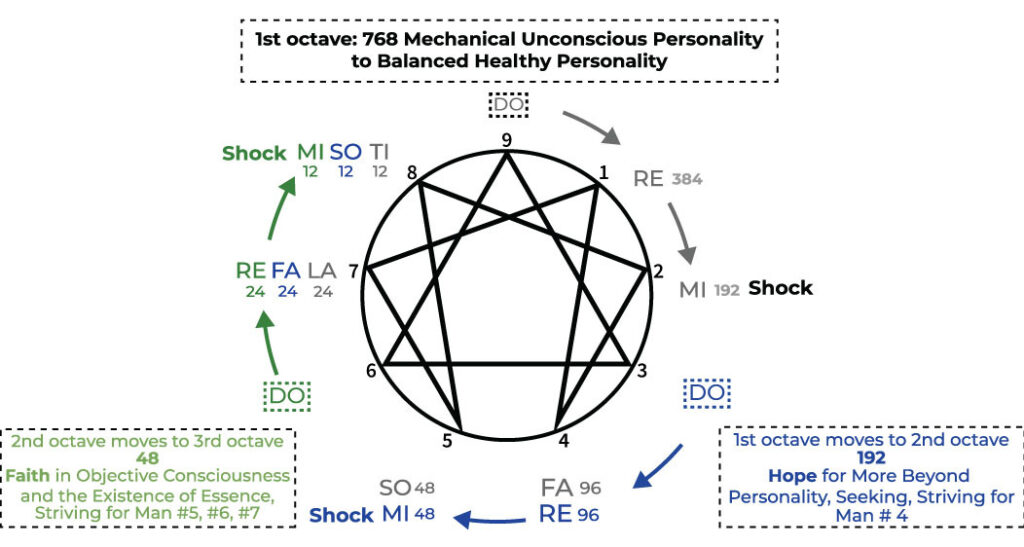
Figure 3.13 Legend: Evolution of Consciousness Reflected in 3 Octaves of the Diatonic Enneagram
| 1st Octave Identity A | 2nd Octave Identity B | 3rd Octave Identity C |
|---|---|---|
| Developing of a relaxed personality, a healthier, more integrated person | Seeking to understand what life really is beyond personality | Revealing of essence, unity consciousness, and unconditional love |
| Unconditional hope non-attachment to outcomes replaces my desire to control The 1st octave starts with developing an integrated, whole personality and completes with dissolving I as the doer and any attachment to outcomes | Unconditional faith and objective reasoning replaces opinion, belief, and blind faith The 2nd octave starts with seeking beyond personality and subjective knowledge and completes with the development of the objective capacities of essence to receive the universe | Unconditional love and inclusion and submission to all in the universe creates an eternal soul The 3rd octave starts with committing fully to the evolution of consciousness and completes with unity consciousness |
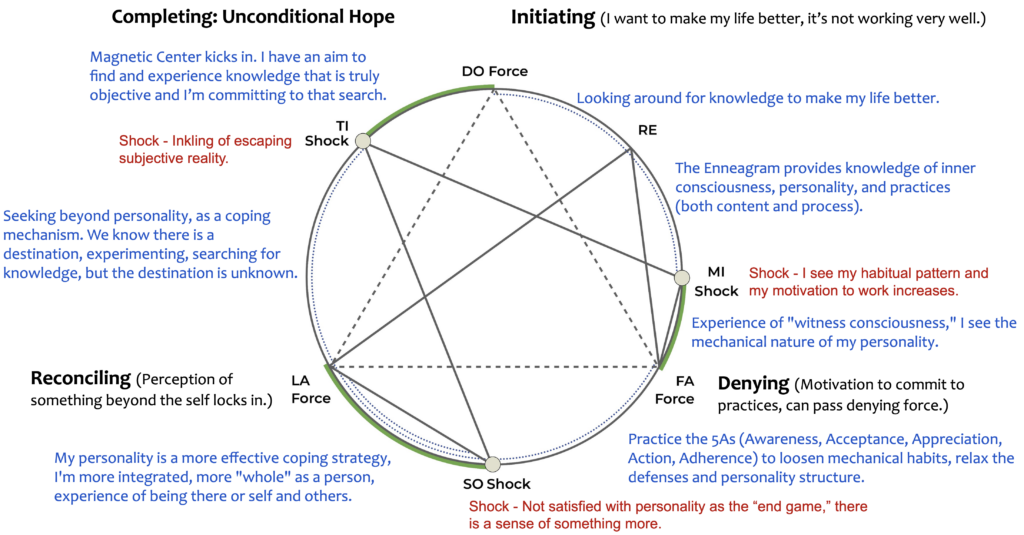
The full description of the 3 octaves are presented in the final three figures (Figures 3.14, 3.15, 3.16). In the 1st octave, attachment to outcomes has been replaced by non-attachment, “I” or personality is no longer the doer, and hope is unconditional, meaning that outcomes will serve the universe of which I am a part of.
Figure 3.14 The 1st Octave: Development of Integrated Whole Personality with Potential for Unconditional Hope
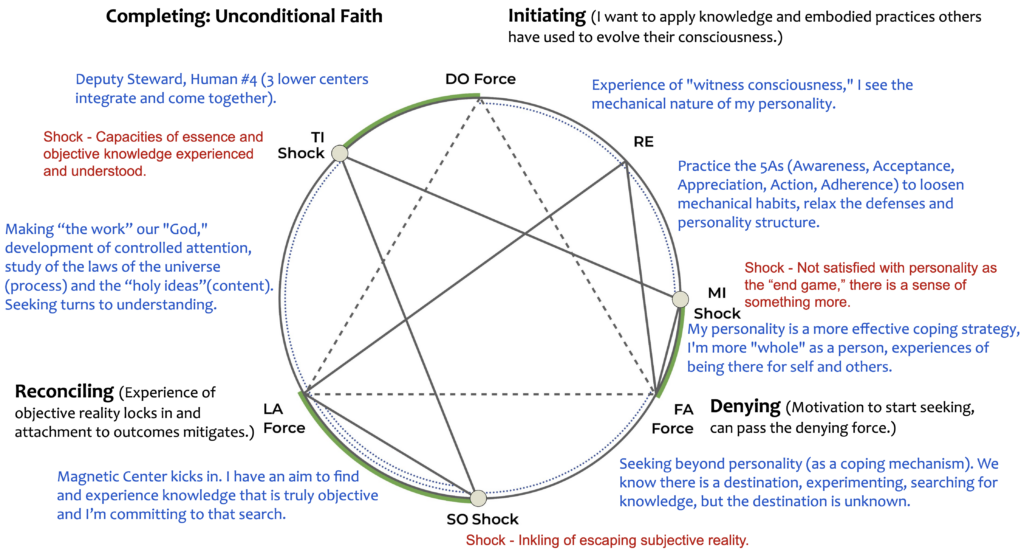
On to the 2nd octave, we can see that at the conclusion of the 2nd octave there is a recognition of non-blind faith, knowing without a doubt that the laws that created the universe exist and that the objective capacities of essence exist to see those laws and connect knowledge objectively.
Figure 3.15 The 2nd Octave: Development of Verifying Something Beyond Personality with Potential for Unconditional Faith
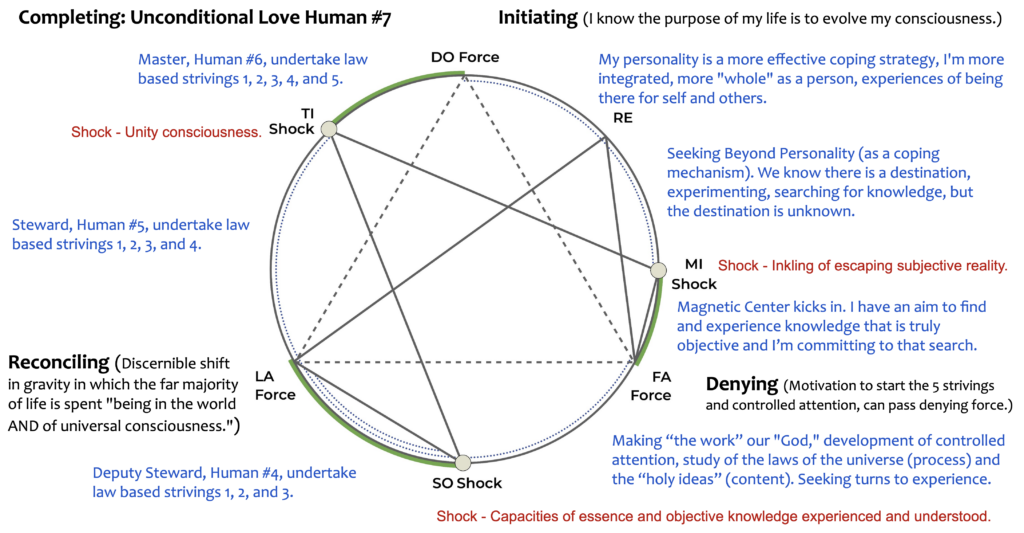
On to the 3rd octave and the completing principle, we can see that the 3rd octave is the embodied submission to all and everything in the one, inclusive love of all that exists; all is forgiven in self and others with no gap between me and not-me, a unified, no-separation existence.
Figure 3.16 The 3rd Octave: Development of Objective Reason and Existence with Potential for Unconditional Love
Part 3 Summary: The Enneagram’s Natural Laws Reveal Pathways to Helping, Healing, and Human Potential
In Part 3 we set out to document and provide brief highlights of the Enneagram of Personality’s contribution to helping, healing, and human potential.
| (1) We brought forward terms or labels from our ancient, traditional psychologies dating back tens of thousands of years. This included: Definitions of Ancient-Contemplative Tradition Labels: • We distinguished between essence and personality. • We examined the roles of coping and consciousness. • We discerned “ordinary consciousness” from “consciousness.” Documentation of Ichazo’s Original Labels • We provided the labels used in the 1970 Arica training to North Americans • Labels included the Holy Ideas versus the fixations • Labels included the virtues versus the passions • Labels included the conservation, relation/syntony, and social or adaptation instincts (2) We provided an orientation to helping and healing in using The Enneagram of Personality. • Identity of Consciousness • Content or intellectual study of why the Enneagram works • Process or embodied experiences or verification of applying practices in your life (3) We highlighted four key concepts useful in helping, healing, and human realization of consciousness. • The Enneagram’s Holy Ideas (Patterns of Wholeness) • The Eneagram’s Harmony triads • The Work and The 5As • The Enneagram’s 3 Octaves of Human Consciousness |