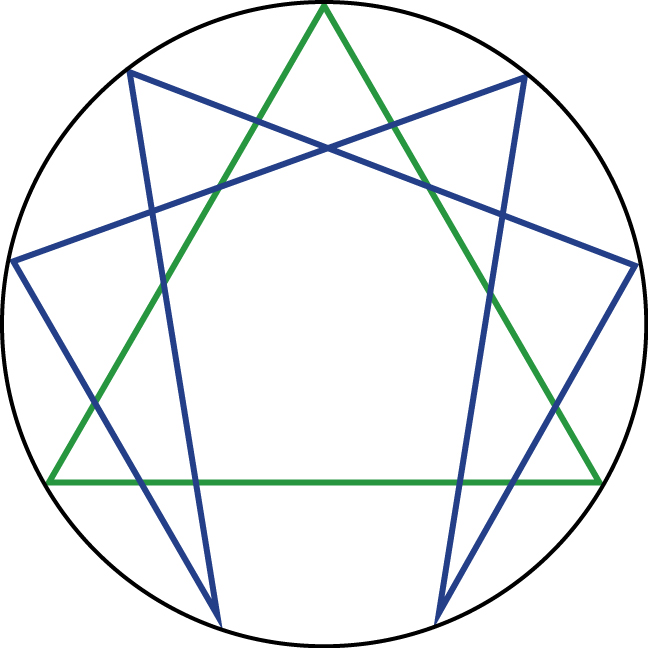
Objective Science Reveals the Fractal Pattern of the Law of 3 and Law of 7 in a Process of Completion and in the Nature of the Content of Personality
Our indigenous and early agricultural ancestors identified two important laws–the Law of 3 and the Law of 7–which shed light on the fractal pattern within the Enneagram diagram. In Part 2, we look at how objective data science reveals these fractal patterns in: (1) the process of completion, (2) the content of personality, and (3) the dynamic motion of consciousness’ evolving potential in 3 octaves.
We address both the Law of 3, the Law of 7, and how these laws unfold in a diatonic octave found throughout the natural world. (A diatonic octave is a seven-note scale, with an eighth note repeating the first.) Understanding this process based on common-cosmic laws is imperative to those studying the Enneagram of Personality as it informs how all humans can evolve their consciousness through 7 inner principles and 3 octaves.
We will provide the mathematical-physical structure of the 9 patterns of personality—a framework bridging abstract mathematics and physical reality, mapping quantitative relationships to describe the content of subjective and objective consciousness. Here, we will reveal why these 9 patterns occur as phenomenological, something Ichazo stated was a scientific discovery of nature. A portion of these natural laws cannot be changed and precisely uncover how we evolve from 1 to 3 to 9 to 27 patterns of personality, however there are some laws that can be changed with awakened consciousness.
Key Questions About the Mathematical Fractal Pattern Revealed in the Enneagram
There are three clusters of questions surrounding the Enneagram symbol that we address:
| 1. Wholeness in 7—The evolutionary process of 7 as revealed in the 7 centers of human development and consciousness • Why are the 3 centers of personality (body, heart, and head), labeled the Instinctual-Moving Center, the Lower Emotional Center, and the Lower Intellectual Center? • What about the 2 other centers in the body: the Sexual Center and the Instinctual Center? • What about the 2 higher centers in the body: the Higher Emotional Center and the Higher Mental Center? 2. Wholeness in 3—The nature of 3, 9, and 27 patterns of personality and consciousness, specifically: • Why are there 9 types, and why those specific 9? What’s the connection between the nine types and 3, 9, 27? • Why are head, heart, and body types grouped where they are around the circle? And why is the number 9 at the top? 3. Wholeness in 9–The dynamic motion of 7 principles and 2 shocks • Why use the Enneagram symbol (a process model) when all 9 types are equal rather than being higher or lower? • Why the inner lines and arrows? • What dynamic movement is objective? |
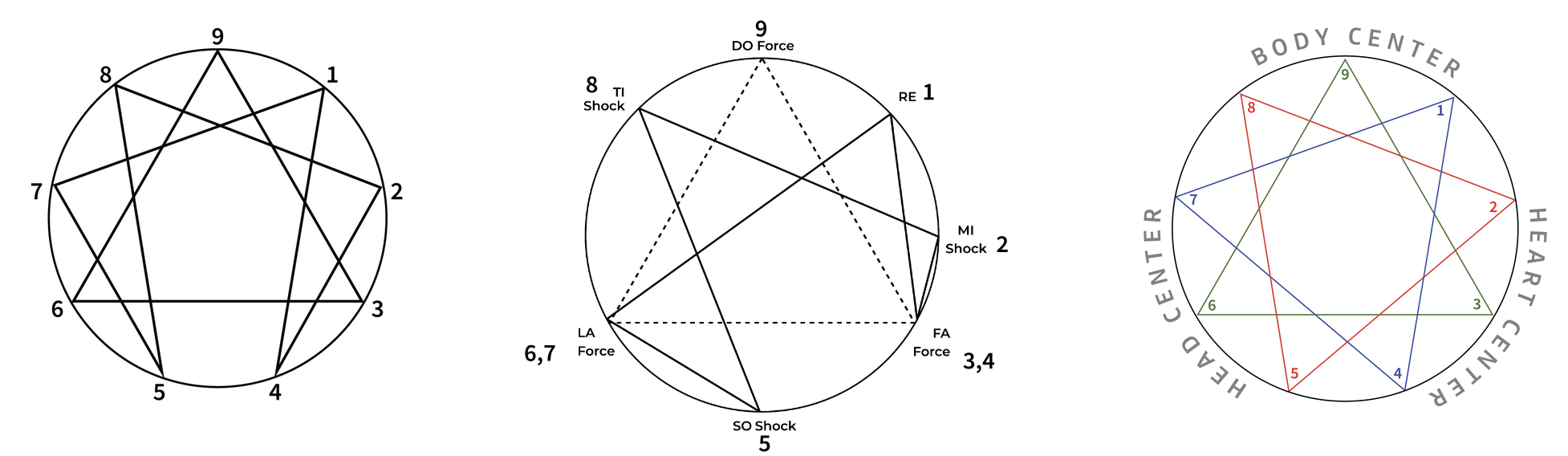
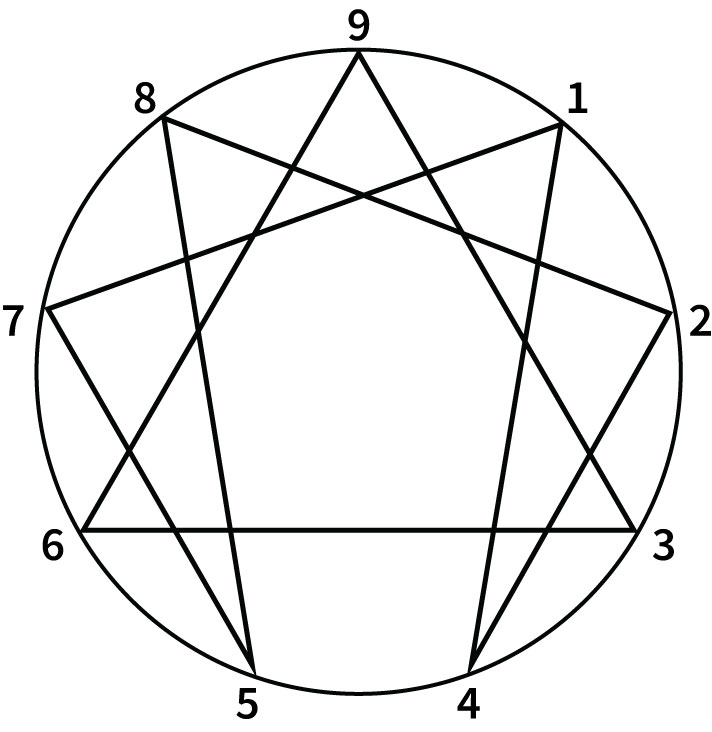
We have found that to be objectively understood, the well-known, traditional Enneagram diagram requires decoding. However, there are also two other versions, the diatonic Enneagram, and the Enneagon Enneagram. The differences are summarized in Figure 2.1.
Figure 2.1 Decoding the Traditional Enneagram Diagram
| The Traditional Enneagram A separated triangle and hexad, 7 principles including 1st octave at 9 and 2nd octave at 3 and 3rd octave at 6. Wholeness in Ninths: Motion Meaning: Consciousness is dynamic, alive, and in perpetual motion. | The Diatonic Enneagram A connected triangle and hexad, the diatonic octave of arising and completion. Wholeness in Sevenths: Process Meaning: Consciousness evolves through the 7 centers of the human body. | The Enneagon Enneagram Three equilateral triangles, each with a unique relationship to consciousness. Wholeness in Thirds: Content Meaning: What consciousness does and does not pay attention to. |
 | 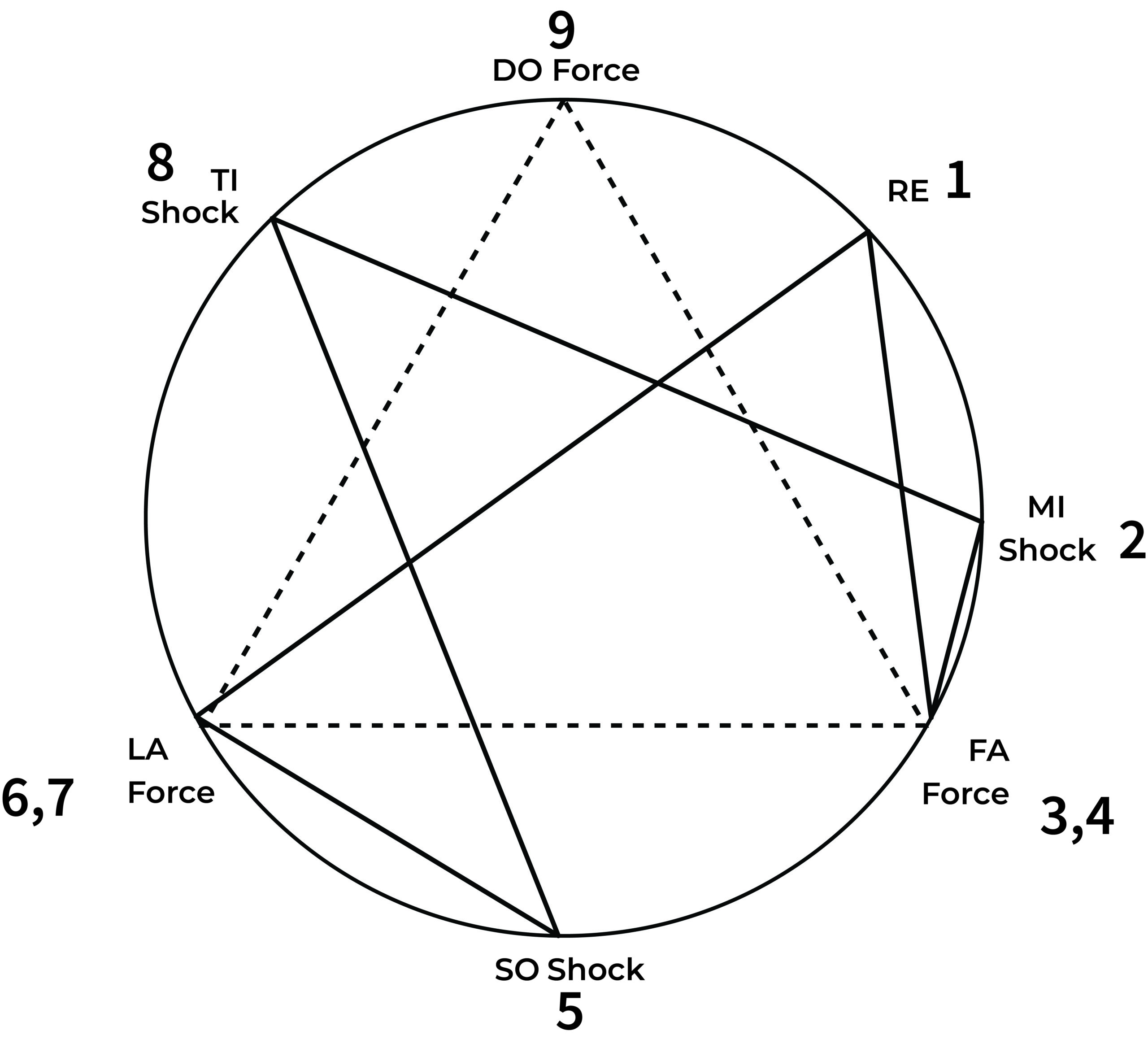 | 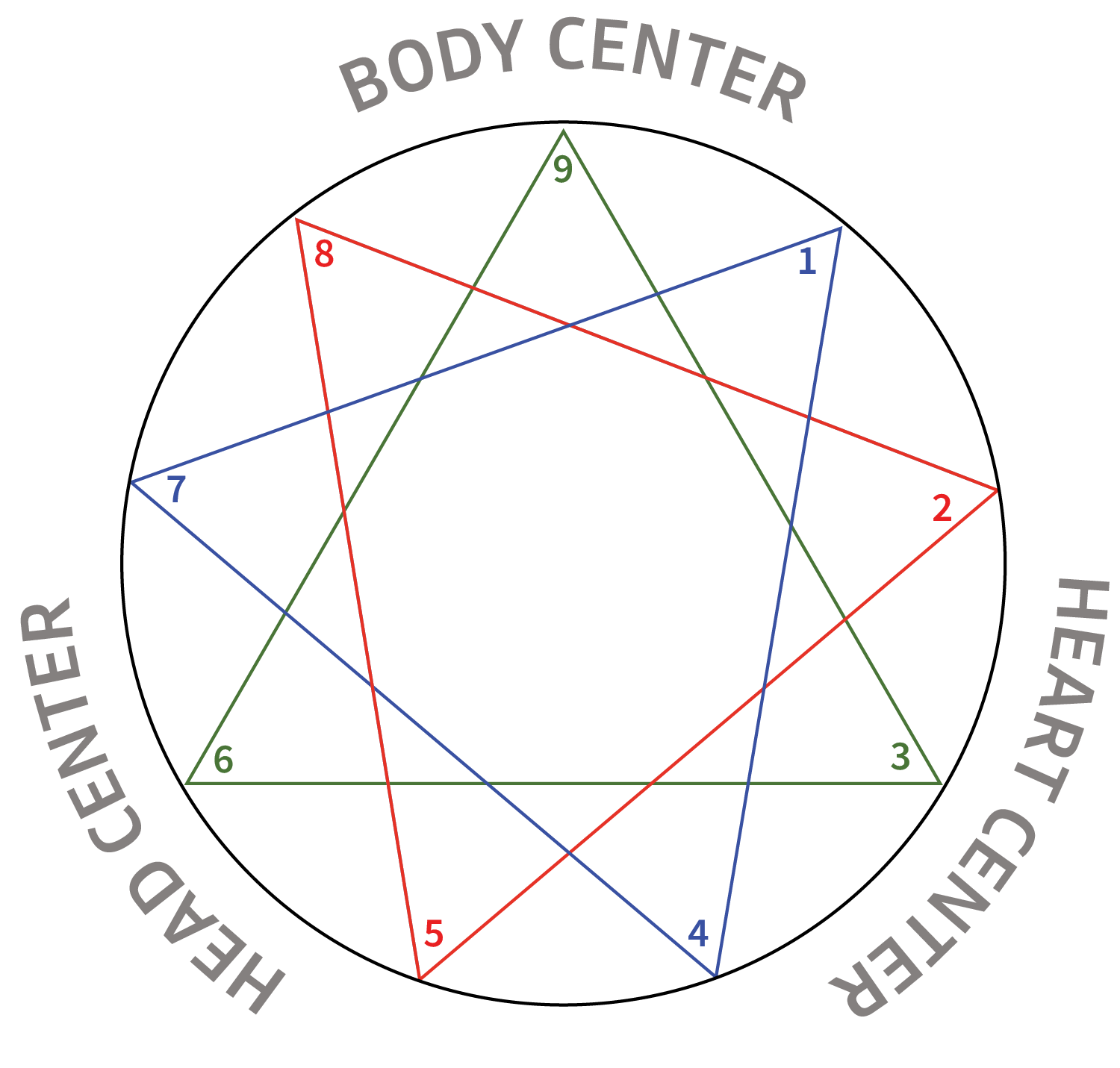 |
The Mathematical Symbols and Laws of the Enneagram
As a next step, we will dissect the mathematical symbols of The Enneagram.
Point – Represents unity in singularity
Circle – Represents Unity in All and Everything. There are infinite points around a circle.
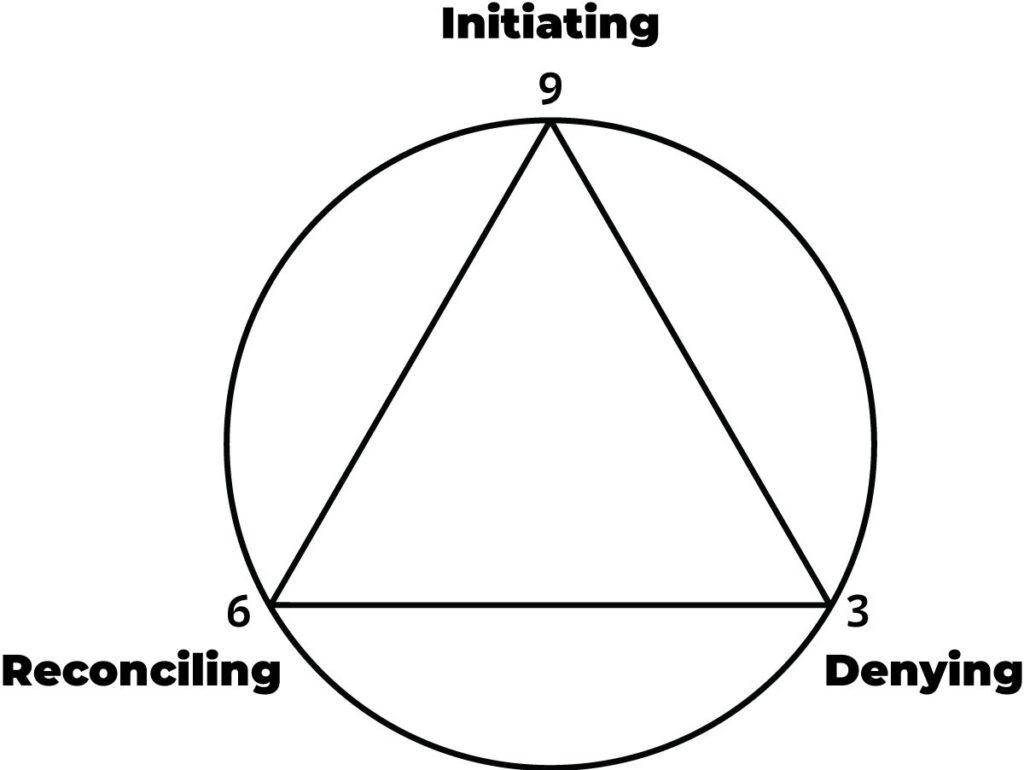
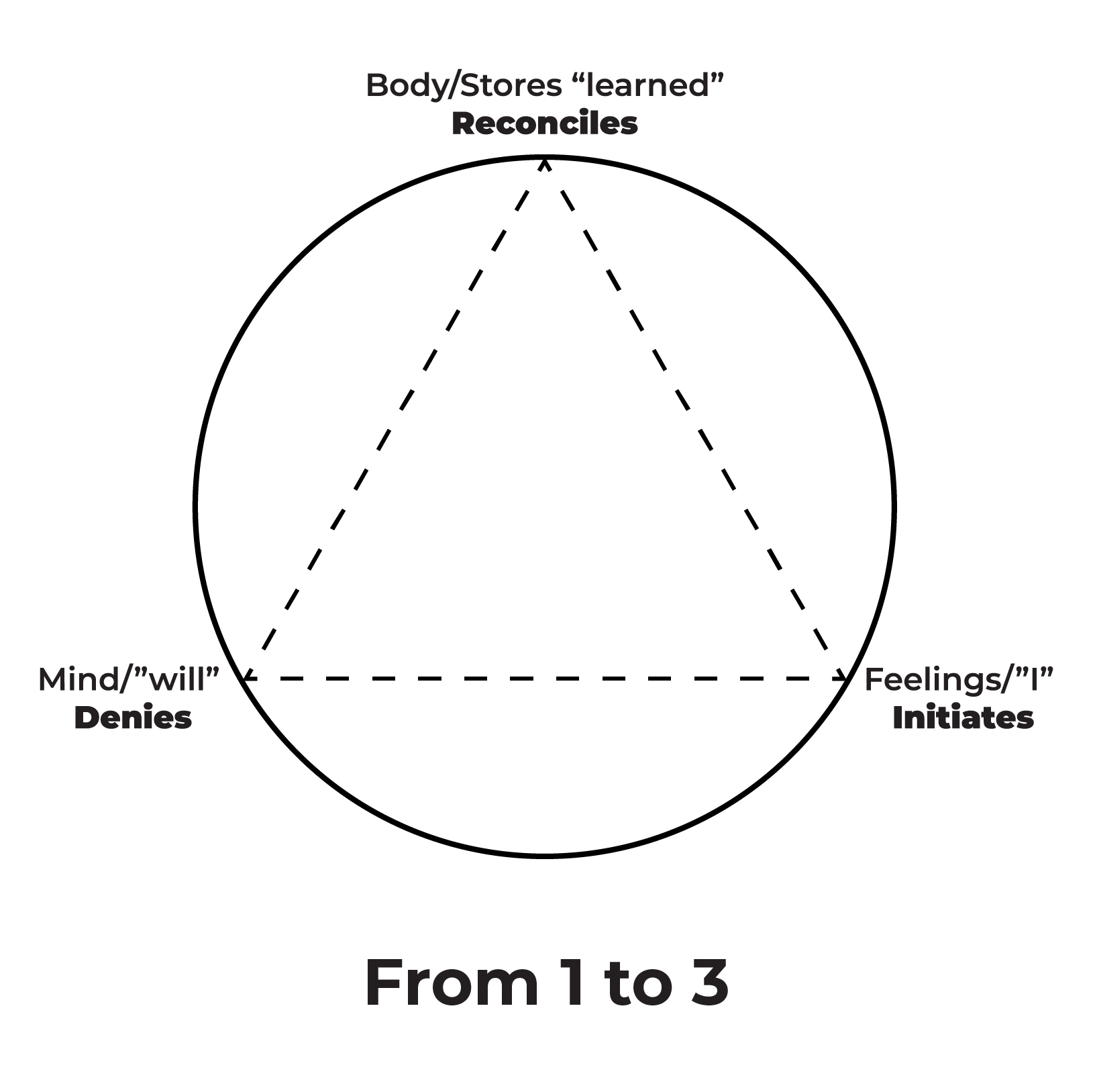
Triangle – Represents Unity in All and Everything. There are infinite points around a circle. a circle. Represents the Law of 3, or Creation. Any new arising produces 3 forces: initiating at 0, denying at 3, reconciling at 6. Completion is back at 9.
Because the Law of Unity (circle) is reflected in all of life, we can examine the evolution of unity around the circle.
The math of the direction of evolution: An evolution of any arising starts at 0 where 9 is placed and evolves clockwise around the circle from 0 to ⅓ to ⅔ to 1. The apex of the triangle at 9 both starts (0) and completes (1) a cycle.
All numbers to 3 divided by 3.
| 0/3 | 0 |
| 1/3 | 0.333333333333333333 |
| 2/3 | 0.666666666666666667 |
| 3/3 | 0.999999999999999999 or 1 |
There are 3 segments dividing the circumference of the circle: 9 to 3, 3 to 6 and 6 to 9.
The labels (Initiating, Denying, and Reconciling) are most often used, but the pattern represented in any arising separated into 3 forces is found in other cosmologies.
| Law of 3 | Force 1 (+) | Force 2 (-) | Force 3 (=) |
|---|---|---|---|
| Ichazo | Action | Reaction (denies world as it is) | Result |
| Gurdjieff | Initiating | Denying | Reconciling |
| Hinduism (cycle of ages) | Brahma | Vishnu (destroyer) | Shiva (sustainer) |
| Christianity | Father | Son | Holy Spirit |
Note: Vishnu and Shiva are often “confused” as one refers to cycle of ages, whereas the orthodox view places Shiva as destroying, followed by creating and Vishnu as preserving. Also it may be that the idea that the Trimurti was based on the Law of Three but applied artificially – assigning specific gods to the aspects of affirming, denying, and reconciling.
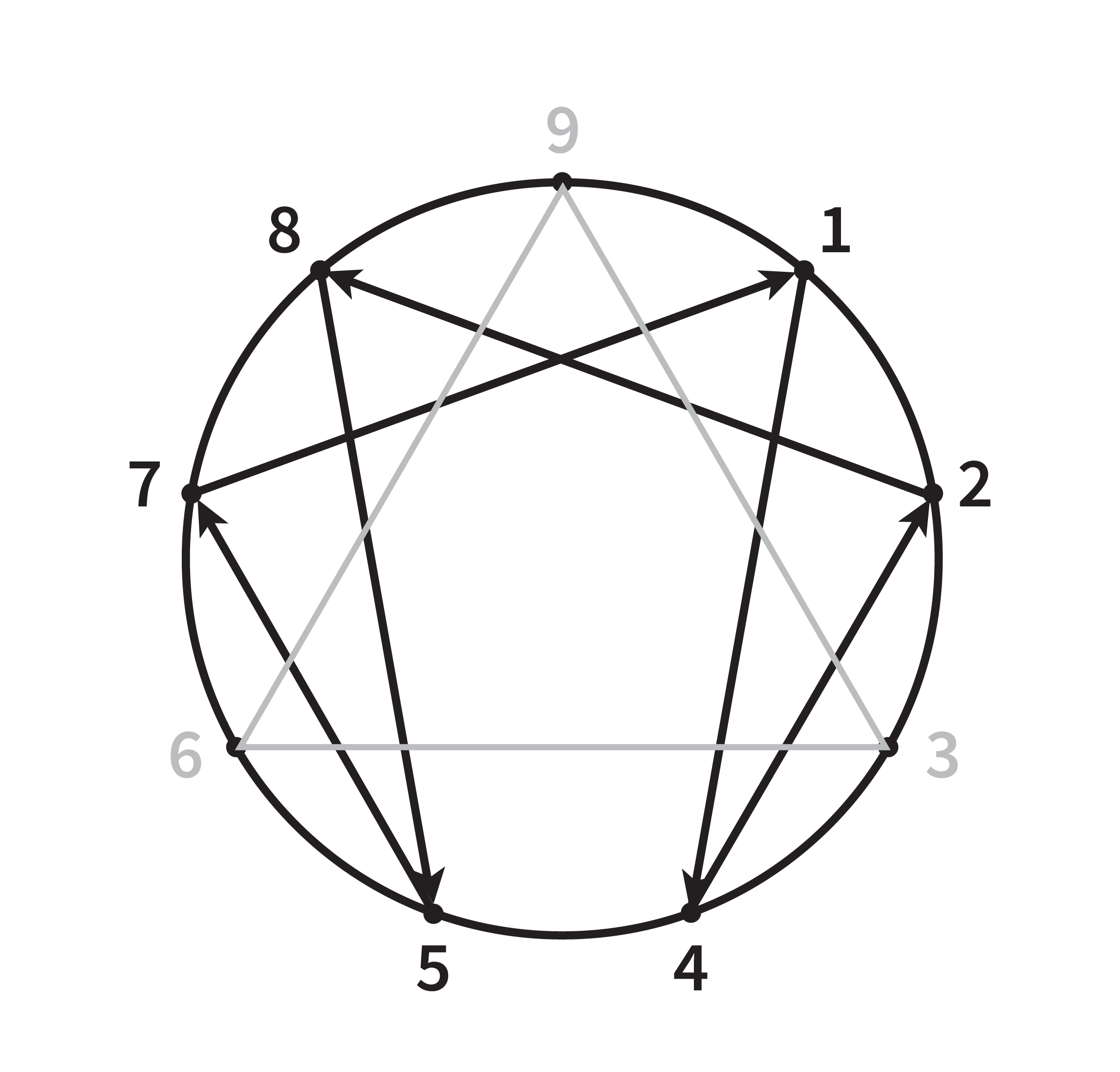
Hexad – Represents the Law of 7 or the way that any new arising produces 7 internal divisions or states. It also represents Maintenance—any arising needs to be maintained. Without maintenance, an arising would subside and die. Any arising, any need, or a new life separates into initiating, denying, and reconciling, and the momentum is maintained through shocks within the Law of 7.
Initiating starts at the top of the circle at 0 and runs clockwise to completion at 9. As 9 at the top represents initiating (0) and completing (9), the hexad must be understood that it also has a completing principle at the top of the circle at point 9, where one cycle ends and another starts.
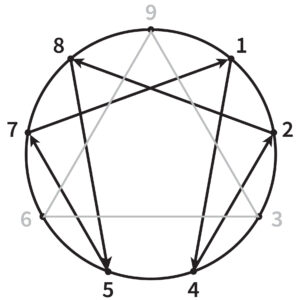
All numbers to seven divided by 7.
| 0/7 | 0 |
| 1/7 | 0.142857142857142857… |
| 2/7 | 0.285714285714285714… |
| 3/7 | 0.428571428571428571… |
| 4/7 | 0.571428571428571428… |
| 5/7 | 0.714285714285714285… |
| 6/7 | 0.857142857412857142… |
| 7/7 | 0.99999999999999999 or 1 |
There are 7 segments dividing the circumference of the circle: 9 to 1, 1 to 2, 2 to 4, 4 to 5, 5 to 7, 7 to 8, and 8 to 9.
Thus, 3 elements of the Enneagram diagram symbolize divided unity:
- Triangle – Wholeness in 3rds
- Truth that any whole arising requires alignment of 3 forces
- The circle has 3 segments around the circumference.
- Hexad – Wholeness in 7ths
- Truth that any whole arising reflects 7 inner principles between potential and completion (7/7 represents 9 at .999999999 or the apex of the circle)
- The circle has 7 segments around the circumference.
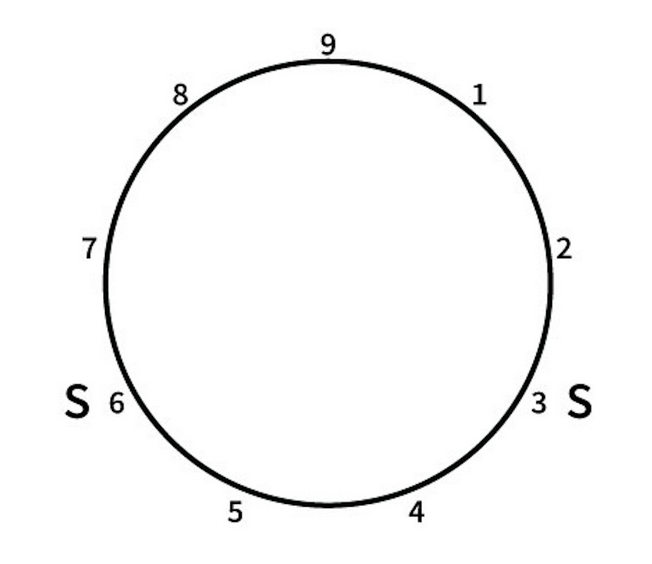
- Circle – Wholeness in 9ths
- Truth that a whole arising is in 3 octaves
- 7 points around the circle 1-2-4-5-7-8 and 9 initiating or DO in the octave of DO-RE-MI-FA-SO-LA-TI-DO, with the first DO also a shock
- 2 more points 3 and 6 as potential for 2 more shocks leading to 2 more octaves
| Note: We use the anglicised version of the solfège, DO-RE-MI-FA-SO-LA-TI-DO using SO, rather than SOL and TI rather than SI). |
Figure 2.2 Wholeness in 3, 7, and 9
| Triangle – Wholeness in 3rds Truth that any whole arising embodies 3 forces Initiating, Denying, Reconciling The Law of 3 | Hexad – Wholeness in 7ths Truth that any whole arising reflects 7 inner principles between potential and completion 1, 2, 4, 5, 7, 8, and 9 The Law of 7 | Circle – Wholeness in 9ths Truth that a whole arising is in 3 octaves 7 points + with potential for 2 more octaves Completion in 3 Octaves |
 |  |  |
Wholeness in 7: The Enneagram’s Diatonic Octave, Process of Evolving, and How We Get to 7 Centers
“The Enneagram Reveals the Mathematical Structure of
— Steven Wheeler, Notes From a Small Village
the Universe, Life, and Consciousness.”
For about 50 years (1950-2000), scholars of Gurdjieff were puzzled by the octave represented in the traditional Enneagram diagram. It conveyed 7 whole notes with two shock points. But the diatonic octave found in sound and light and throughout natural phenomena follow the diatonic octave of 5 whole notes and 2 half notes.
Simple processes were offered on the 7 whole notes, such as making a meal or writing a book. Then, in 1993, Gurdjieff scholar Russell Smith decoded Chapter 39 of Beezelbub’s Tales to His Grandson. Here, Gurdjieff provided essential clues to aligning the forces in the triangle with the deflection points of the hexad, while point 9 at the apex of the triangle, representing completion, remained at the top.
The Diatonic Octave (see Figure 2.3 in next section) reveals the mathematical structure of the universe complete with 3 forces, 7 deflection points (5 whole notes and 2 half notes), 3 shocks, 3 oscillations, and 3 octaves so that anything that arises has the potential to complete.
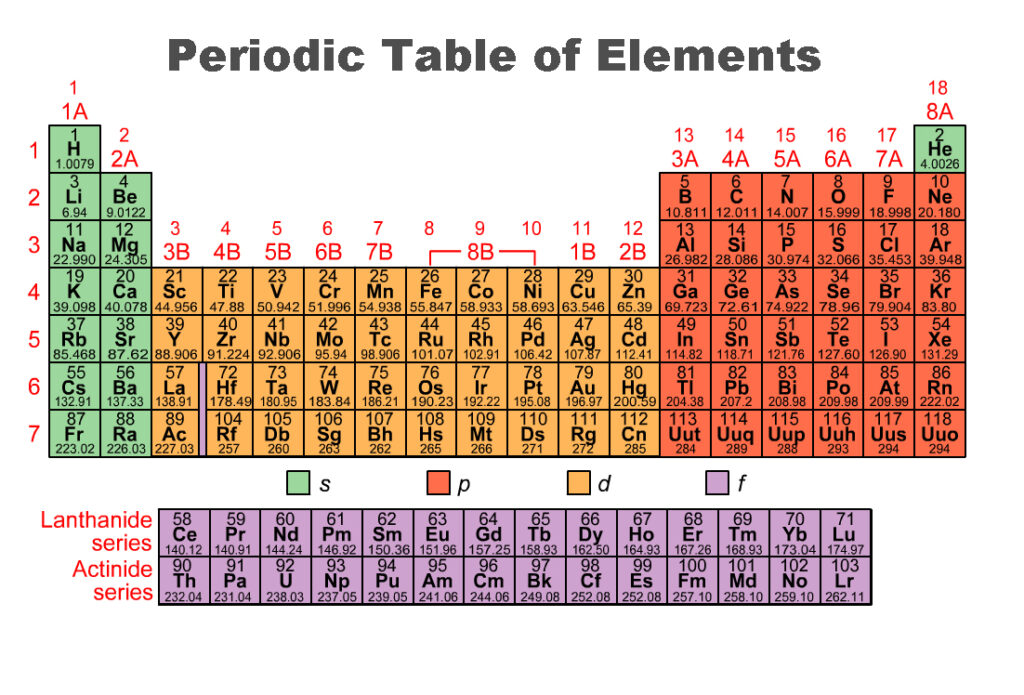
The Law of 3 and the Law of 7 aligned with the diatonic octave reveal the mathematical structure of the building blocks of the universe, including examples from physics, chemistry, and biochemistry, for example:
- Vibrational patterns in sound and light
- Proton, neutron, and quark basic structure
- Periodic table of elements
- S subshells, P subshells, D subshells, F subshells in electron orbits and energetic states of quantum electrons
- Transfer RNA simple structures
- Gurdjieff’s Cosmic Secrets by Russell Smith provides verifiable insight into the mathematical structure of the subshells of both the periodic table of Elements and the tRNA codon loop.
The Mathematical Elements of the Diatonic Octave
“All life is mathematics.”
— Gurdjieff quoted by Russell Smith Gurdjieff: Cosmic Secrets
The mathematics of the diatonic octave were described by the Greek philosopher and natural scientist Pythagoras. It uses simple fractions that produce harmonious chords: DO-RE 1/8; DO-MI 1/4; DO-FA 1/3; DO-SO 1/2; DO-LA 2/3; DO-TI 7/8; DO-DO 3/3. We present very basic principles here, however the cyclical nature of the diatonic octave goes much deeper.
Figure 2.3 The Diatonic Octave
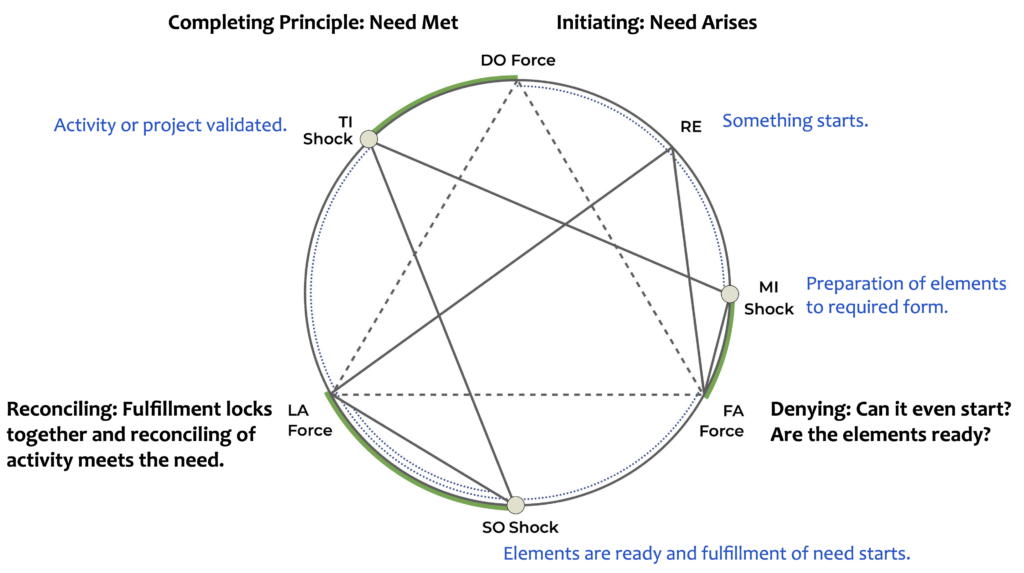
Figure 2.3 Legend: The Diatonic Enneagram—Wholeness in Seven
| Elements of Diatonic Octave | Placement on Circle |
|---|---|
| 3 Forces | DO: Initiating FA: Denying LA: Reconciling |
| 7 Deflection Points (also 7 stopinders or curve segments of 7 inner principles) | DO: Initiating (Arising) Shock enters RE: Starting (Really Starting) MI :Shock enters FA: Denying SO: Shock enters LA: Reconciling TI :Shock enters |
| 3 Shocks | FA Enters at MI-FA LA Enters at SO-LA DO Enters at TI-Do |
| 3 Oscillations | DO-Mi FA-LA SO-TI |
| 3 Octaves | 1st starts at DO, point 9 2nd starts at DO, FA or point 3 of Octave 1 3rd starts at DO, LA or point 6 of Octave 2 |
How Do We Get to the 7 Centers in the Human Body
With a very basic introduction of the diatonic octave, we can now answer this question.
The 7 centers are known in the Enneagram of Personality, with particular focus on the 3 centers of intelligence that are capable of learning and from what Gurdjieff called Man #1, #2, and #3—the Instinctual-Moving Center (or Body Center), the Lower Emotional Center (or Heart Center), and the Lower Intellectual Center (or Head Center), where personality largely operates.
In very simple terms, the 3 lower centers of intelligence can be discerned as follows:
- The Lower Instinctual-Moving Center can notice through senses and movement how water pools in a hollow rock.
- The Lower Emotional Center can intuit drinking safely from said rock instead of visiting the dangerous river or spring.
- The Lower Intellectual Center can formulate a plan for making better hollow rocks that can hold more water.
In addition to these three, there are two lower centers of function (Sexual and Instinctive) that are concerned with species and organic integrity, and two higher centers that are concerned with direct knowing, witness of the subjective and objective.
With a full understanding of the diatonic octave, Smith in Gurdjieff: Cosmic Secrets objectively discerned how the 7 centers in the human body evolved over billions of years. We know that neurobiological connections of sensorimotor, emotional, and mental cognition are distributed throughout the body. So, what exactly did Gurdjieff mean by centers?
The 7 centers are centers of function of essence (inborn or innate capacities). Within all 7 centers, we start out with:
- Attention (input): Consciousness or attention that is presence or being or existence
- Internal Processing: Memory of DNA (including natural or pure instincts)
- Act/Behavior (output): Will as aligned with the evolution of the universe itself
As we grow, personality grows out of essence and we also develop:
- Attention: Consciousness or attention that is mechanical or drawn
- Internal processing: Memory from learning (including distorted instincts)
- Act/Behavior: Will or a perceived small will, aim or intent, sometimes called mind
As mechanical attention, memory from learning, and perceived will accumulates from learned sensorimotor, emotional, and cause–effect thinking, this accumulation acts as a center of gravity highly influencing our personality.
In very early childhood, we lose sight of or experience with essence (the pure capacities of our nature). For example, essence has the capacity to taste, but what foods we like or dislike come from learned associations within our family and culture. Sensing differences in the environment is the pure capacity of essence, but assigning value—such as good and bad or right and wrong—to human and cultural differences comes from learned associations.
It is interesting to note that five of the centers have consciousness. The sexual center is pure memory of the duplicating principle of DNA (learning is limited to successful genetic adaptations). The Instinctual Center operates automatically and does not require learning, but exceptions can occur.
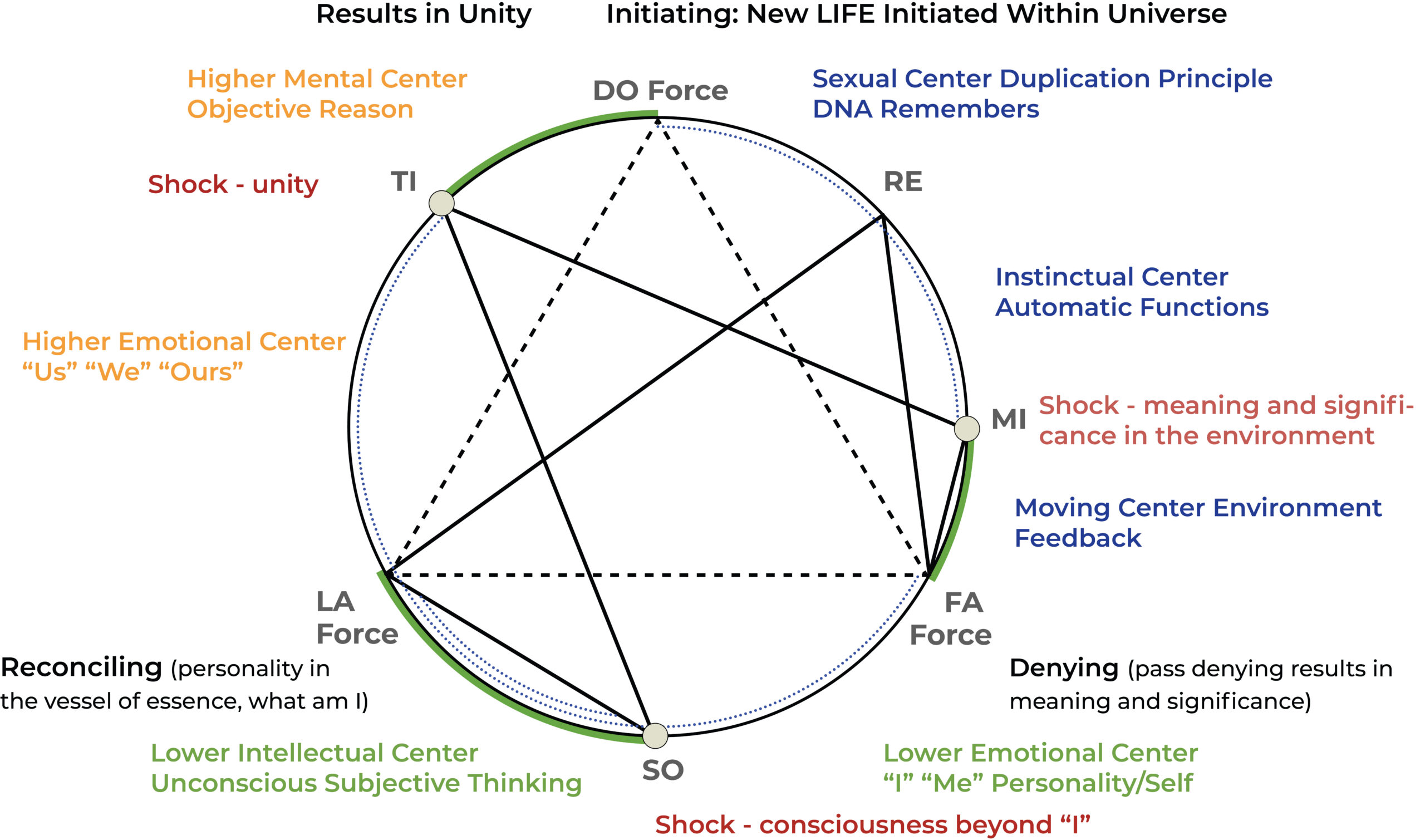
Each center can now be visualized in Figure 2.4: The Law of 7 Structure Coalesses into 7 Centers of Function and in Figure 2.5: Evolution of the 7 Centers in the Diatonic Octave.
The 7 centers are found in the 7 parts of the circumference (or inner principles) of the circle between two deflection points (also called notes or vibrations).
As the structure follows the Law of 7, the column titled 7 Inner Stages is the stopinder between two notes. The column titled 7 Centers with Brief Descriptions briefly describes the functions in each center. The column titled Evolution of Consciousness in All of Life, starts with the evolution of viruses, proceeds to bacteria and plants, then invertebrates and vertebrates, higher-order mammals, and humans.
Figure 2.4 The Law of 7 Structure Coalesses into 7 Centers of Function
| 7 inner stages | 7 Centers with Brief Descriptions The 7 Centers are centers of function of essence. Within all of them we find memory, will, and attention. | Evolution of Consciousness in All of Life |
|---|---|---|
| DO-RE | Sexual (Reproductive) Center •Duplicating Principle •DNA—species and family memory—provides a pattern for the growth and development of essence, the material for essence comes from the universe, first through the mother and then directly within our own body | Viruses and all other plants and animals |
| RE-MI | Instinctual Center •Automatic (involuntary) functions of the body, no learning required •Instincts carry forward to all centers | Bacteria and all other plants and animals |
| MI-FA | Instinctual-Moving Center (part instinctual, part lower learning due to oscillation in the octave) •Mechanical attention with link between Instinctive and Moving Center •Associations between body and environment stored •Builds a map of how physical objects behave from which motor functions can become directed, rather than just instinctive •Aim or will to use our physicality to close gaps between me and not-me, or desired and not-delivered •Instinct to survive and thrive dominant (i.e., self-preservation) | Invertebrates, vertebrates, and few plants |
| FA-SO | Lower Emotional Center •Mechanical attention •Associations between internal feeling states and environment stored •Builds a map of significant connection between one experience and another within stable relationships •These internal feeling states are the result of cognition of meaning and significance. We call it intuition or emotional intelligence because there’s no reason to it, no rational model of cause and effect, just the association of cause and effect •Aim or will to use our intuition to close gaps between me and not-me or desired and not-delivered •Instinct to connect with species dominant (i.e., relation, sexual) | Invertebrates, vertebrates |
| SO-LA | Lower Intellectual Center •Mechanical attention •Subjective reasoning stored •Develops chains of cause and effect that lead to a model (inner beliefs) about how the world works •Aim or will to use tools and objects of tools with chains of cause and effect between them to close gaps between desired and not-delivered •Instinct to master the environment dominant (i.e., adaptation, social) | Some invertebrates, vertebrates |
| LA-TI | Higher Emotional Center •Controlled attention on internal focus provides energy •Provides witness consciousness for our inner state and the inner functions of the lower centers •Experience of impartiality and non-attachment active •We/us/our and survival of all of life is natural state | Mammals, the higher emotional center remains more intact in many mammals, in comparison to humans, for example, sacrifice under predation; humans can develop this consciousness through controlled attention and other embodied practices of presence |
| TI-DO | Higher Mental Center •Controlled attention on external focus provides energy •Provides witness consciousness for the essence in situ, i.e., objective to the self and the inner state •Objective reason manifests with the capacity to relate to the natural flow of forces, of which subjective reason is but a surface result | Humans, although rare it is possible for humans to develop this center of pure objective reasoning; the vast amount of localized knowledge is now connecting to the larger universe and many chains of cause and effect |
These 7 centers can now be placed around the Enneagram’s diatonic octave in the 7 stopinders, seen in Figure 2.5.
Figure 2.5 Evolution of the 7 Centers in the Diatonic Octave
Of great relevance to the Enneagram of personality, before the conditioned personality develops, the 3 forces operate as follows:
- DO to FA
- The world initiates (asserts through body and senses)
- MI to FA represents the Instinctual-Moving Center (Body Center) where sensorimotor learning is stored
- FA to LA
- The emotions deny the environment
- FA to SO represents the Lower Emotional Center (Heart Center) where intuitive learning is stored
- LA to DO
- The intellect attempts to reconcile, either to make the world align with the emotions or to help emotions be satisfied with the world. Typically, the result flows back through the body as reaction.
- SO to LA represents the Lower Intellectual Center (Head Center) where cause–effect learning is stored (called intellectual center, not mental center as it is reserved for the mental capacity of cause–effect learning)
Wholeness in 3: Instincts, Essence, and Enneagram Personality Types: From 1 to 3 to 9 to 27
Objective science based on the mathematical/physical laws of the universe provides an objective method to reveal how we get to 27 personality types. These natural laws are outlined in Figure 2.6.
Objective science requires that you can explain not just the what but also the why and how, and that is only possible if you know the laws that created the universe in the first place. Throughout this section, we explain the why and how of the 27 types of personality.
Figure 2.6 Overview of Natural Laws Explaining the Development of 9 Personality Types
| NATURAL LAWS THAT WE CANNOT CHANGE Physical Experience of a 3-Fold Universe Monad: Experience of unity (no separation) Dyad: Experience of duality (tension of opposites) Triad: Experience of three forces (initiating, denying, reconciling) Reciprocal Maintenance Existence and evolution is possible because of the cosmic principle that all things are interconnected and mutually support each other through an exchange of energy and substance, sometimes referred to as “Just as we use, we serve,” or, “Just as we eat, we are eaten.” Reciprocal maintenance happens instinctively and unconsciously, it requires no drive. •Self: We use our personality to close the gap of separation/suffering •Other: Our personality serves by bringing value to others and the environment Diatonic Octave of 7 Centers, 3 Shaped by Learning Evolution has created 7 centers within us: •2 based on memory and automatic behavior •3 based on conditioned learning and thus called the lower centers: Instinctual-Moving, Emotional, and Intellectual •2 based on the potential to develop consciousness and thus called higher centers Born with Essence (Biological and Neurological DNA) We are born with essence (a term used by Gurdjieff to describe our biological and neurological DNA). Although essence is often confused with being born with a soul, the natural law of essence simply states we are born with biological and neurological attributes and capacities. Essence evolved to serve we, us, and ours, an external consideration of the survival of all of life. Our personality develops through blending of our DNA with conditioned learning and internal consideration of our state, serving I, me, and mine. Our essence is unchangeable with the exception of mutations to our DNA. NATURAL LAWS THAT CAN BE CHANGED WITH CONSCIOUSNESS Law of Conditioning At birth, we begin to learn. Our attempts to close the gap between me and not-me are conditioned by the environment we live in. Of all the natural laws, this is the one we can change through controlled attention and development of our consciousness. Complexes-of-the-Functioning, or Opposites in the Whole of Us A constant struggle between the higher being body and the physical body exists within us, however, this struggle or tension to achieve unity can shift with the development of consciousness. Higher Being Body (Potential for 3 unconditioned higher qualities) •Unity, or unconditional love •Non-attachment, or unconditional hope •Objective understanding of the universe, or unconditional faith Physical Body 3 initiating instincts supporting the evolutionary purpose of the universe) •Instinct to survive and thrive (after birth, a separate body is experienced) •Instinct to connect with our species (after birth, a separate doer/connector disconnected from the laws of the universe emerges) •Instinct to master/understand our environment (after birth, a separate mind that learns conditioned or subjective knowledge grows) Capacities of Essence to Receive Impressions Objectively We have many capacities of essence (our biological and neurological DNA), and nine are key to receiving impressions objectively. These 9 capacities blend with conditioned learning leading to personality. With consciousness essence can emerge again. Experiencing 8 – Coming to the world with an open innocent mind 1 – Seeing differences without assigning familial, cultural, or societal value 9 – Inclusive love that we are all part of Allowing 2 – Giving and receiving to naturally unfold 4 – Connections to naturally arise 3 – The universe to be the doer Knowing 5 – Ample and objective knowledge is available 7 – Possibilities emerge in a full-spectrum and a time and season 6 – Without doubt that objective reality with capacities of essence exist |
Essence, Personality, and How We Get to 9 Types
The simplest laws of objective science are all unfolding simultaneously and there are countless octaves between the 3 instincts and the 3 higher qualities. Thus, we will provide a step-by-step view of the physical and mathematical laws of starting from how we get from 1 to 3 types, then to 9 and finally to 27 personality types.
From 1 (or Unity) to 3 Types
The movement from essence to personality is an organic and necessary part of the evolution of consciousness (from mechanical to controlled to objective consciousness). We are born with automatic survival instincts on the one hand, but also with potential for higher capacities. This creates suffering and struggle which resolve through the development of consciousness.
At birth, the infant is in the world, instead of being the world.
— Steven Wheeler, Notes From a Small Village
The new world brings new sensations (reminders) of separation.
There is now an outer world and an inner world.
So, how do we get from unity (represented by 1 point in mathematical abstraction) to nine personality types (represented by 9 equidistant points that cluster around a circle of infinite points)?
We know that before birth, a child experiences implicit unity with its environment, simply being. There is no boundary, no sense of me and not me. There are senses, but they encompass the whole of the world. After birth, a child finds itself separated from that world of wholeness and thrust into another. The infant yearns for continuity, for the simplicity and completeness of that former world, but it cannot return.
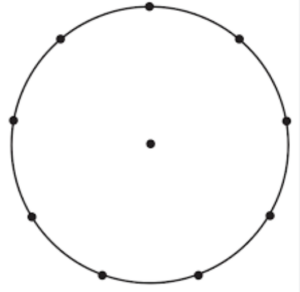
We remember a womb that no longer exists. The newborn wishes to restore unity, and a fetal position can rapidly be discovered (or remembered). Because the Instinctual Center has memory—it requires no learning—the newborn experiences that we are separate from the world around us. It comes very fast, and the Instinctual Center detects intrusions to an internal state. Within moments of the birth process starting, the newborn is detecting me and not-me. This is a very different experience from the prior nine months.
Three types develop very quickly. Early temperament, based on DNA in the Instinctual Center, along with very early experience determines whether our innate essence relies on:
- Physical dominance, Body Center (Gurdjieff’s Human #1)
- Emotional dominance, Heart Center (Gurdjieff’s Human #2)
- Intellectual dominance, Head Center (Gurdjieff’s Human #3)
From the laws of objective science, we see that the nine personality types develop from simple laws that are the result of many, many interactions from a 3-fold physical and mathematical structure, starting with the physical experience of a 3-fold universe (see Figure 2.6).
In the unity of the entire universe—in which we are all included—the universe or the world initiates. However, with a new life and the development of a personality to cope with the physical sensation of separation, the 3 forces—affirming, denying, and reconciling operate differently.
Figure 2.7 reveals the intersection of the 3 forces and of a new life in the universe. We start with the top of the triangle at DO, in black, the world initiates, and a new life once in being or unity (sometimes labelled love) is born. At birth, we experience the outer world and my body (the me and the not-me). In blue is the loss of a unified being experience and instead we experience disharmony of the world.
Figure 2.7 How We Experience the 3 Forces which Create our Personality
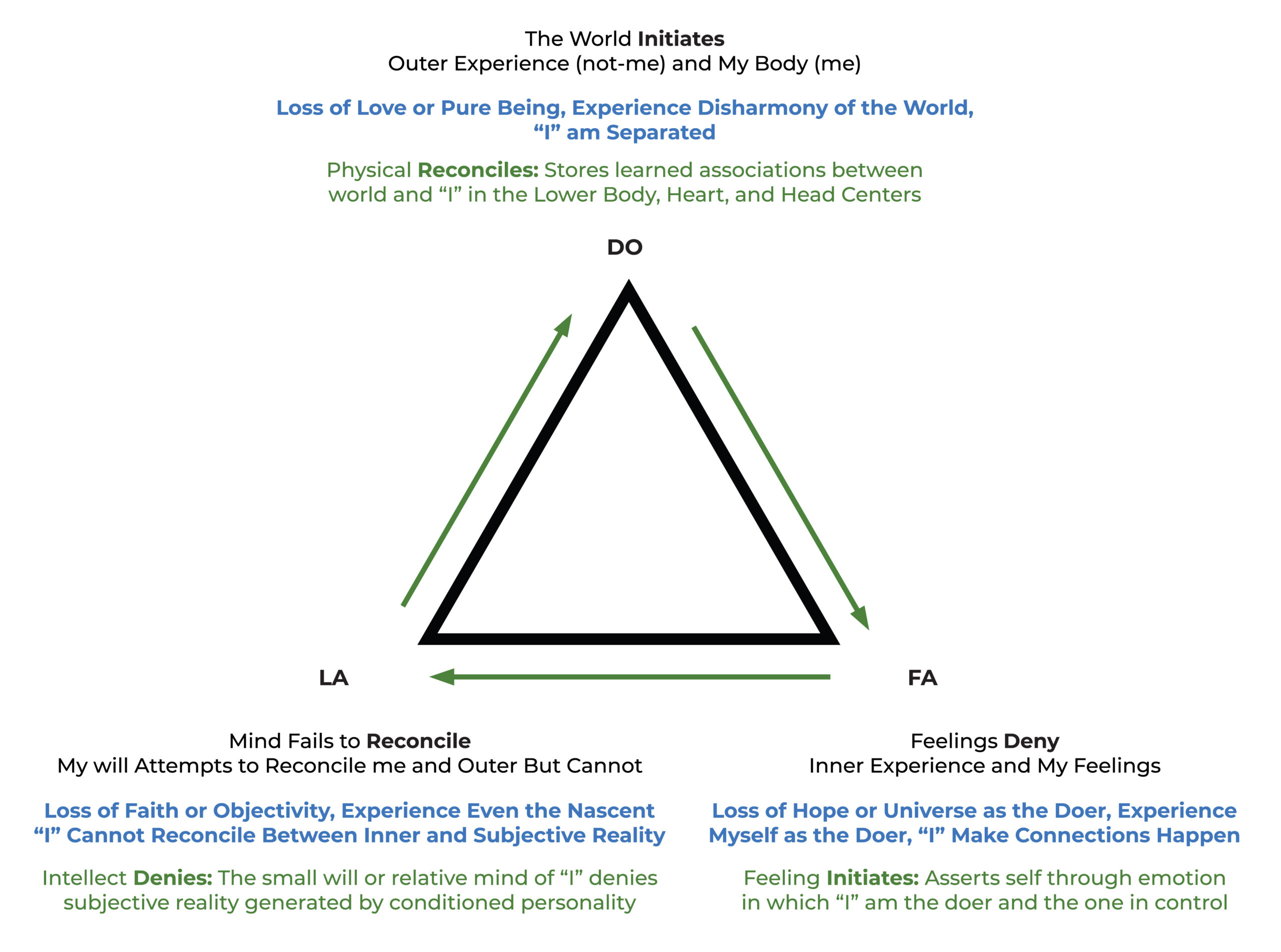
| Figure 2.7 Legend: The same force occupies different positions depending on whether the universe (black writing) or the ego (green writing) is the initiating principle, and the labels rotate accordingly. The same force can rotate to each center simply based on experience, reaction, and situation. |
Going clockwise after DO, we come to FA, the denying force (the text in black). Feelings and sensations inside the body begin to deny the world with feelings initially of separation anxiety, but very soon after other aversive emotions. That the universe is the doer and will take care of me, also called hope (in blue) is experienced as a fundamental loss. The gap between the internal state and the environment can take time to close or become wide. The result is that we as very young infants begin to initiate to align the self with the environment. What is at first a denial grows to become a wish to change, and the self initiates to close the gap (in green).
Continuing clockwise after FA, we come to LA, the reconciling force (in black). The nascent separate-ego with a will or mind attempts to reconcile the gap between internal sensations and the external environment. As the I initiates from a subjective or relative location in time and space, the ego fails to reconcile internal and external (in blue) and becomes the denying force (in green writing). This is also called the fundamental loss of objective seeing as the personality rather than the universe is initiating from a relative position (also called the loss of faith).
Still continuing clockwise after LA, we return to DO, our body. Now with I or personality initiating at point 3 on the Enneagram, and mind denying at point 6 on the Enneagram, the body reconciles, by storing the accumulation of conditioned learning at point 9 on the Enneagram. For example, as a young infant we learn that crying brings the mother and the gap between me and not-me closes quickly. On the other hand, crying might not bring our caretakers despite our hunger or fear or sadness or anger. Both success and failure, both small and large gaps between what we desire or need and what the environment actually delivers gets stored in our moving, lower emotional, and lower intellectual centers, all in our physical body (noted in green).
As humans, we now have three dyads separate from the whole:
(1) a separate being or body (Lower Instinctual-Moving Center),
(2) a separate doer/I formed from aversive feelings (Lower Emotional Center), and
(3) a separate mind or will attempting to align me and not-me (Lower Intellectual Center).
These 3 lower centers respond to learning and each of them carry a dominant instinct. Together, they build the 3 core types:
- Leading with the Instinctual-Moving Center: This core type finds success in closing the gap of separation by filtering the world through a kinesthetic or moving-boundary intelligence, including physical sensations, gut instincts and movement, which serves to empower our pursuit of the instinct to survive and thrive. We store strategies to assure our place in the world and to minimize discomfort.
- Leading with the Lower Emotional Center: This core type finds success in closing the gap of separation by filtering the world through intuition and relational attunement, which serves to provide bonding and the instinct to connect with our species. We store strategies to meet and receive the vital needs for connection, contact, and approval.
- Leading with the Lower Intellectual Center: This core type finds success in closing the gap of separation by filtering the world through forming associations between cause and effect, which serves to ensure certainty and the instinct to master our ecological and social environment and make it more amenable. We store strategies to gain security through analyzing, envisioning, and planning, and use cause-effect thinking to build solutions and tools.
| Note: Numerous Octaves Build the Personality Structure Each human experience and reaction is a new world with its own process octave. And depending on the situation, each center can initiate, deny, or attempt to reconcile. Our steps are trying to reduce complexity; however, the composite traces of all these octaves gradually build the mechanically defended and reactive personality that Naranjo’s work describes or what Ichazo originally described as fixations of distorted consciousness. |
From 3 Types to 9 Types
To get to the 9 types, we can see steps within the diatonic octave. A new life begins relying on one of the three centers. Now we have four more steps, relating to deflection points in the diatonic octave, these steps will be described in a linear order, however they all operate together, and lead us to the 9 aspects of essence and the nine types. These processes are:
- Essence responds to separation (RE-MI)
- Struggle for wholeness acts in relation to the world (MI-FA)
- Reciprocal value is exchanged in the world (FA-SO)
- Innate essence is protected by personality (SO-LA)
1: Essence Responds to Separation
A young child’s essence (containing their innate capacities, temperament, drive for wholeness, and natural instincts) responds to the stress of separation (depicted in Figure 2.8).
Figure 2.8 A Child’s Initial Separation Creates the 3 Nuanced Responses of Their Essence
| Separation of being divides into 3 separations of or from truth, perfection, and love • The outer world is diverse and has many manifestations: I should be able to fix the inharmonious world. • The outer world is harsh and inharmonious: I should have more inner harmony and less randomness. •. Even a single entity exhibits what seems like infinite diversity of essence: The essential nature of an entity should have knowable bounds. Separation of feeling also divides into 3 separations of or from providing, connection, and law • The inner world is shocked repeatedly by unexpected needs: I should be able to count on the needs of the world being met. • The inner, nascent I cannot see connections between its experiences; The world should be able to reveal the origin of connections and nurture them. • Nothing seems constant enough to form connections reliably: There should be a lawful way for connections to form. Separation of will also divides into 3 separations of or from intent, confidence, and predictability • Intent seems to be deflected by an external force: I should be able to overcome any denying force. • Even when intent is not deflected, the capacity to complete is weak and unformed: The world should be more potent toward my own intentions. • Events come in from left field and make intent meaningless: There should be a way to control my environment to make it more predictable. |
2: Struggle for Wholeness Acts in Relation to Not-Me
With 3 experiences of separation, the drive to close the gap between me and not-me unfolds in 3 relationships to the world. These movements include being, becoming, and a combination of the two. In his recent books, Ichazo (2024) also uses the terms externalizing and internalizing, as well as action, reaction, and resulting to describe these same movements. These movements form the three equilateral triangles possible in a circle with nine equidistant points.
- 3 types (8, 2, 5) move outward to the environment, as if my being can close that gap
- 3 types (1, 4, 7) move inward to inner state , as if my becoming can anticipate closing the gap
- 3 types (9, 6, 3) move outward with being and inward with becoming to close the gap of separation
| Note: Act For — Act On — Act With: From Ichazo, to the Jesuits (1971) to Wheeler on the Daniels’ Harmony Triads (2026 A Jesuit priest, Bob Ochs, learned the Enneagram from Naranjo in 1971. He described and documented 3 relationships we have to the world which can be summarized as act for the world, act on the world, or act with the world.. Jesuit theologian turned philosopher Tad Dunne (1999) in some of his lectures from 1971 to 1973 described being as an outward movement whereby I experience self as bigger than my environment, thus shaping the environment I share with others (a movement of types 8, 2, and 5). Similarly, he described becoming as an inward movement and experiencing self as smaller than my environment thus adapting the environment for others (a movement of types 1, 4, 7). And he described being and becoming as a dyadic movement while experiencing myself as locked in to my environment, thus mediating outward and inward (a movement of types 9, 6, and 3). Beesing, Nogosek, and O’Leary (1984) describe 8, 2, 5 as “I am bigger than my world,” 1, 4, 7 as “I am smaller than my world,” and 9, 3, 6 “I must adjust to my world.” And Hurley and Dobson (1992) labeled it the way of subjugation by meeting life head-on 8, 2, 5, the way of reduction by reacting to life 1, 4, 7, and the way of mediation by negotiating with life 3, 6, 9. Based on Daniels Work on the Enneagram Harmony Triads, Wheeler (2026) describes the 3 relationships to the world or universe as: act for, act on, and act with [others]. Wheeler’s description is illustrated in the third of the four processes. |
3: Reciprocal Value is Exchanged in the World.
The lawful purpose of the universe informed by the diatonic octave is an evolution of reciprocal systems in which the universe serves life, and life serves the universe (see Figure 2.6). As infants, our instinctual need to survive, to bond, to be cared for are met by those who care for us. These caregivers help us to adapt to our environment, and they make the world more amenable for us. In turn, as we develop, we discover that our essence provides value to our environment and the world we live in.
- 3 types turn outward to meet and influence the world (8, 2, 5) achieving value by acting for others.
- 3 types turn inward to anticipate the world (1, 4, 7) achieving value by demonstrating their idealization thus acting on others.
- 3 types participate by acting with others in the world in a dyadic movement of inward and outward (9, 3, 6) achieving value by mediating between demonstrating inner value on others and acting for others.
As a young child attempts to reconcile between me and not-me, one of the 9 responses of essence becomes both successful in compensating for separation and for bringing value to others and the world. All centres act in all attempts to ‘close the gap’ but one may dominate in any given attempt. Each success is remembered as a pattern for the future and over time we lean into our perceived strength. (See Figure 2.9.)
Figure 2.9 Centers, Direction of Response, and Value to Others
| In the Physical Center, primarily driven by the instinct to survive and thrive We can act for the universe by protecting others from harm (Type 8) We can act on the universe by making ourselves perfect and share our idealization with others (Type 1) We can act with the universe by minimizing self and blending with others to prevent conflict, preserving peaceful environment (Type 9) In the Emotional Center, primarily driven by the instinct to connect with our species We can act for the universe by meeting needs or making connections for others (Type 2) We can act on the universe by making ourselves the ones who connect our shared existential concerns and desires and share them with others (Type 4) We can act with the universe by identifying with doing and make sure others want and need what we do (Type 3) In the Intellectual Center, primarily driven by the instinct to master our environment We can act for the universe by helping others to solve their problems (Type 5) We can act on the universe by making ourselves the ones with wisdom (Type 7) We can act with the universe by questioning the nature of reality for self and others (Type 6) |
We see that personality is our coping mechanism to deal with the suffering of separation, with the gaps between I/desire (from within) and what the universe delivers (from without). It is our repeated attempt to reconcile the gap.
While the Enneagram of Personality informs us of coherent coping strategies to bridge our gaps of discomfort, challenge, conflict, large conflicts—and the widest gaps, which we label as trauma—the Enneagram also informs us of how we bring value to others and the world as part of a fundamental biological principle governing the exchange of energy for the harmony of the universe.
4: Essence is Protected by Personality.
As our chief feature or primary fixation gets better at closing the gap between me and not-me and providing value to the universe, something interesting happens. Our chief feature of personality serves to protect the particular quality of essence that responded to separation.
The nine qualities of essence which allow us to receive impressions free of conditioning “go into the background.” Our essence is still there, but we have learned to use our essence based on our conditioned learning, thus, the personality represents a distorted aspect of essence. The other 8 essence capacities, although being present in the background by the time of young adulthood, are a bit more natural, although partially distorted, compared to the distorted essence protecting our chief feature or fixation. The 9 capacities of essence to receive impressions objectively are shown in Figure 2.10.
Figure 2.10 An Enneagon and 9 Aspects of Essence with Capacity to Receive the World Objectively
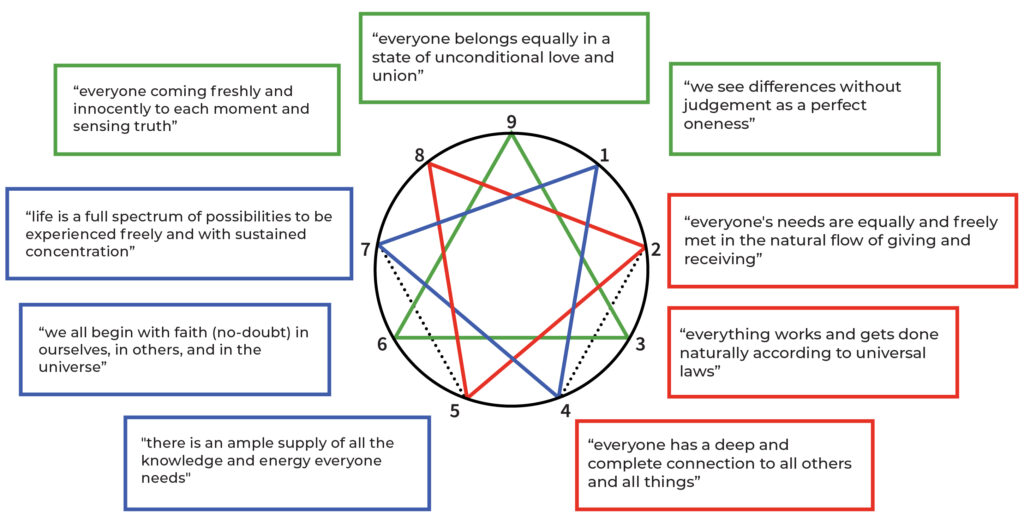
| Figure 2.10 Legend Box colors – the 3 centers Line colors – the 3 behavioral strategies of value to self and other |
Summary: From 3 Types to 9 Types
Figure 2.10 presents a brief summary of how we get from unity to three types to nine types.
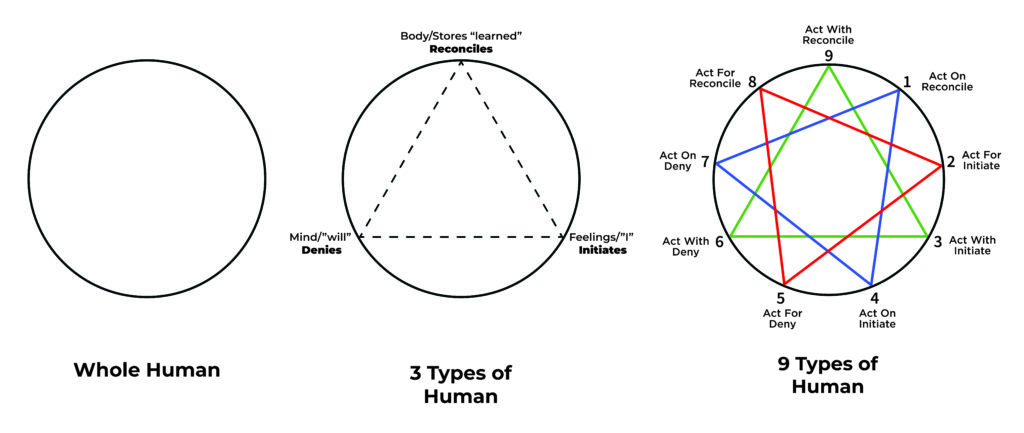
From unity, a very early reliance on one of the 3 centers emerges, each with a dominance in Physical, Emotional, or Intellectual attention and processing. Feelings/I are initiating (2, 3, 4), intellect/mind is denying (5, 6, 7), and the body is reconciling by storing our learned successful and unsuccessful attempts to reconcile between me and not-me.
This explanation along with Figure 2.10 are mathematical abstractions. In reality, the process is not this simple. All 3 centers, 3 instincts, 3 higher being bodies, and the 3-fold relationship to the world are operating simultaneously and together.
We compensate for lack of wholeness in our relationship to the world. And we seek ‘value’ in the world: we seek to justify and protect our existence.
Figure 2.11 Essence Divides Into Thirds: From 1 to 3 to 9 Personality Types That Compensate for Wholeness and Bringing Value to the World
Pure Points and “Wings”
As a mathematical abstraction, the circumference of the circle with infinite points represents that we do not, in fact, have pure points. Wings in the Enneagram of Personality are very common. The wings on either side of a point inform us that we learn other coping strategies in closing the gap between me and not-me. But with the circle being made up of infinite points, a Type 4, for example, could be anywhere along the line between 3 and 5. If it’s closer in proximity to the 5, it represents a very strong 5 wing—thus taking on the coping strategies of the Type 5.
Enneagon – Wholeness in Ninths
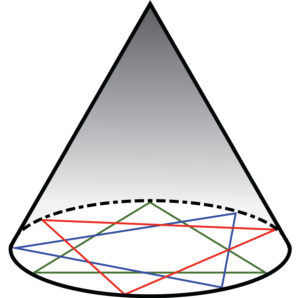
All centers and all types can use all three strategies of relating to the world (act for, act on, act with). Let’s continue with Type 4 as an example, focusing on the act on triangle.
- A pure Type 4 resists the environment and turns inward to create an idealized world, acting or improving on the environment.
- A Type 4 with a 5 wing also receives the environment, looking to understand it as it exists, acting for others by bringing them knowledge.
- A Type 4 with a 3 wing also attempts to balance what is felt inside and what is experienced outside, acting with others.
Although the pure point (midway between two types) is the more common expression, we could end up anywhere along the line as we develop.
From 9 to 27
“Three brained beings, during Babylonia….
— G.I. Gurdjieff Beezelbub’s Tales to His Grandson
were well versed in what is called the ‘law of type,’ and were well aware of
the twenty-seven quite distinct types
of three-brained beings on their planet, and even of what the beings of
each type would inevitably perceive in this or that situation,
how they would perceive it, and what would have been their reaction.”
We know through Gurdjieff’s writings of ancient objective knowledge that we do not live in a dying universe but in an evolving universe. In fact, we learn from Gurdjieff that the purpose of the universe in entirety is to evolve, and the purpose of a human life is to evolve our consciousness.
All of life exists in a framework that gives the possibility of evolution, instilling involuntary instincts through survival. These instincts are not a pattern of reconciliation or completing. Rather, they are Initiating Forces (instincts of life itself, affirming of life). The instincts are 3-fold:
- All of life seeks to survive and thrive
- All of life seeks to connect with its own species
- All of life seeks to master its environment (to make it more amenable)
So, how do we get from 9 to 27 types?
Objectively, we know that the instincts are automatic—they are not learned. Instead, they are the result of millions of years of evolution. Figure 2.12 displays how Gurdjieff, Ichazo, and Naranjo described the 3 instincts remarkably similarly. Most importantly, is the distinction between the pure instincts and the distorted instincts.
Figure 2.12 Description of the 3 Instincts in Natural/Pure, Partially Distorted and Distorted Forms
| Gurdjieff: 3 Instincts | Ichazo: 3 Instincts | Naranjo: 3 Instincts |
|---|---|---|
| The 3 instincts of life flow from DNA in the Sexual Center into all centers, and become partially or fully distorted in personality | The 3 pure essence instincts become distorted in personality of the Centers of Feelings (Sensations), Emotions, and Thoughts respectively | The 3 pure instincts of the Instinctual Center channel into the Lower Emotional Center becoming distorted in personality |
| To survive and thrive Pure: We each sacrifice ’self’ (as needed) to enable others to survive Partial: My social group or gene pool (extended family) survives Impure: I survive; I have protection from the elements and enough to eat and drink | Conservation Pure: Give according to ability, receive according to need Distorted: Self-preservation for me and my family | Self-Preservation Pure: Acknowledged, not described Distorted: Adapted Ichazo’s Conservation Instinct to Karl Marx hunger survival drive in describing character disorder |
| To connect with our own species Pure: I know that neither I nor my genes are special; we help life to achieve its purpose Partial: My family group remains dominant Impure: I receive what is due to me; I transmit my genes and my worldview | Relation/Syntony Pure: Meet everyone essence to essence, inclusive, open, non-judgemental receptivity of others Distorted: Form relationships selectively, exclusively with important others | 1:1/Sexual Pure: Acknowledged, not described Distorted: Adapted Ichazo’s Syntony/Relations Instinct to Sigmund Freud sexual bonding drive in describing character disorder |
| To master the world (to understand and fulfill the needs of the universe) Pure: We each seek to understand the needs of the universe and of others beyond my own reach Partial: My environment and social group accepts me. My rank and standing are clear Impure: The world bows to my right to be | Social/Adaptation of Social-Ecological Environment Pure: Working in groups flows naturally, things (external and internal) fit together through doing, true commune, true contribution Distorted: Adapt external situations to own purposes, “games” of social interactions around working and doing, becomes a cover-up for lack of activity and lack of group contribution | Social Pure: Acknowledged, not described Distorted: Adapted Ichazo’s Adaptation Instinct to Object Relations drive for care and affection with those outside “me” in describing character disorder |
Naranjo writings present the 3 instinctual subtypes in the Enneagram emerging from 3 pure instincts that become distorted in the emotional center of personality, but the nature of the pure instincts were not articulated by Naranjo, given his focus on psychiatry and psychopathology.
The only documented Ichazo description, we could find, of the nature of the pure instincts is in the chapter titled, The Arica Training, described by Dr. John Lilly and his associate Joseph Hart. This chapter provides a very brief description of how the 3 pure instincts were taught in the 1970 Arica Training (Pure, Column 2, Figure 2.11). Each brief description aligns with the objective knowledge brought forward by Gurdjieff in that the instincts serve the purpose of survival of all of life and with Ichazo’s will to live. The instincts are a form of will.
Naranjo referred to the pure instincts as free (free to automatically act without learning) versus bound (constricted to conditioned learning of the personality), but, as mentioned, Naranjo did not specifically articulate the pure or free form.
| Note: The Instincts and Society The distorted instincts are very recognizable to us, whereas the pure instincts may be perceived as idealistic to a human society. The pure instincts are easier to see in the animal kingdom. A dolphin pod with predation of an Orca informs us of the pure conservation instinct in which the oldest male dolphin or one that is diseased or injured sacrifices himself so the others live. Similarly, a beta lion will submit to an alpha lion so that the pride carries on the strongest genes, which informs us of the pure 1:1 or sexual instinct. An ant colony informs us of the pure social instinct, in that there is an organized division of labor and the vast majority of the individual ants in the colony are contributing. |
Summary: From 3 Types to 9 Types to 27 Types
We now have Figure 2.13 revealing the 3, 9, and 27 types. We start with reliance on one of the 3 centers as a result of initiating (I/feelings), denying (mind/will), and reconciling (body storing successful and unsuccessful attempts to close the gap between me and not-me). Within each dominance of the center, we have our relationship of consciousness with the universe: outward to meet consciousness and influence the world by acting for others, inward to receiving consciousness of the universe and developing the new ideal for others. A dyadic attempt to balance both. All of the instincts are initiating and affirming life.
Figure 2.13 From 3 to 9 to 27 Personality Types Summarized
| Center | Relation- ship to World | Distorted Instinct | Center | Relation- ship to World | Distorted Instinct | Center | Relation- ship to World | Distorted Instinct | |||
| Type 2 | + | Act For | SP | Type 5 | – | Act For | SP | Type 8 | = | Act For | SP |
| Type 2 | + | Act For | 1:1 | Type 5 | – | Act For | 1:1 | Type 8 | = | Act For | 1:1 |
| Type 2 | + | Act For | SO | Type 5 | – | Act For | SO | Type 8 | = | Act For | SO |
| Type 4 | + | Act On | SP | Type 7 | – | Act On | SP | Type 1 | = | Act On | SP |
| Type 4 | + | Act On | 1:1 | Type 7 | – | Act On | 1:1 | Type 1 | = | Act On | 1:1 |
| Type 4 | + | Act On | SO | Type 7 | – | Act On | SO | Type 1 | = | Act On | SO |
| Type 3 | + | Act With | SP | Type 6 | – | Act With | SP | Type 9 | = | Act With | SP |
| Type 3 | + | Act With | 1:1 | Type 6 | – | Act With | 1:1 | Type 9 | = | Act With | 1:1 |
| Type 3 | + | Act With | SO | Type 6 | – | Act With | SO | Type 9 | = | Act With | SO |
| Figure 2.13 Legend Reliance on 3 Centers: (+) Feeling Initiates, (-) Intellect/Will Denies, (=) Body Reconciles by Storing Learning Relationship to the World : Act For, Act On, Act With Distorted Instinct: SP Self-Preservation, 1:1 One-on-One, SO Social |
Wholeness in 9: Dynamic Motion of Consciousness in the Enneagram’s Inner Lines/Arrows, 3 Octaves, and The Harmony Triads
Why use the Enneagram symbol (a process model) when all points have equal capacity for fixated consciousness and expanded consciousness?
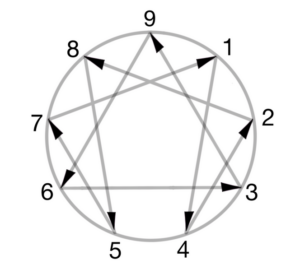
Why the inner lines, and arrows?
Why do the triangle arrows go counter-clockwise away from evolution, or initiating to reconciling to denying?
Why do the hexad arrows follow the decimal of .142857?
Answering these questions from objective science remains a work in progress. We will present what we know to date, and we ask for those that have objective knowledge about the use of the lines and arrows in the Enneagram of Personality to write to us. We remain open and curious.
What We Know About the Enneagram’s Inner Lines and Arrows
Gurdjeff did not use arrows on the Enneagram inner lines. The inner lines of the triangle denote wholeness in 3, the 3 segments around the circle. And the main purpose of the 6 hexad lines is to signal wholeness in 7 around the circle with the implicit, not explicit, inclusion of the DO at point 9. Gurdjieff writings suggest that the decimal of .142857 reveal lines of supervision to the Diatonic Octave’s potential to assist the completion of an arising need. Indeed, students of Gurdjieff and Ouspensky (J.G. Bennett in particular) revealed that the clockwise triangle represented evolution, while the flow of .142857 represented the lines of supervision of an octave (Bennett, 1974).
Maurice Nicoll and Rodney Collin both proposed the flow of .142857 to represent the direction of evolution (Nicoll, 1952; Collin, 1954). Of significance related to personality, Rodney Collin’s theory of celestial influence with increasing light vibration mapped to .142857 and 7 personality types no longer holds as we now know the moon is not a planet.
Although decimal fractions were not revealed and introduced to the Middle East until 500 CE and the Diatonic Enneagram had been known for thousands of years before that, Gurdjieff scholar Russell Smith provided objective knowledge of what he referred to as the lines of supervision used in the process Enneagram (not the Enneagram of Personality).
The cycle of the hexad is not headed anywhere; it simply is. It represents a line of the flow of blending (and thus of influence) within a process of world creation or maintenance. The alignment with decimal fractions is not simple coincidence, nor is the line derived from the decimal fraction sequence. Rather, both follow from the mathematics of prime numbers: the sequence is inherent to the prime number 7.
Gurdjieff did use the “multiplication” of the inner lines for movement-dance starting with .142857, then multiplied Gurdjieff used the multiplication of the inner lines for movement-dance starting with .142857, then multiplied it by 2, 3, 4, 5, 6, and 7. We examined each of the multiplications, and they do not follow the Enneagram of Personality arrows.
Ichazo also did not use arrows on the Enneagram inner lines. Like Gurdjieff, Ichazo presented the traditional Enneagram diagram symbolically. He stated that an enneagon of 3 triangles is inscribed in an Enneagram with 3 centers (abdominal, thoracic, cranial cavities).
As described above, Ichazo in his documented interviews and speeches referred to loss of being at 9 leading to false personality at 3, leading to fear generated by living in subjective reality at 6. This completes with storing learning at point 9, resulting in a clockwise triangle of 9 to 3 to 6 to 9 (Ichazo, 1981).
In his 2024 book, The Enneagrams of the Divine Forms, Ichazo reveals the structure of the Enneagram Diagram with:
- The monad: The will to survive
- The dyad: The tension between wholeness and the suffering of separation
- The triad: The suffering of separation leading to the desire for it to be different, and then fear on account of the inability to reconcile the gap between me and not-me in a subjective world. Ichazo also notes that Suffering 9 to Desire 3 to Fear 6 compose the Buddhist triad of ego suffering
This direction from 9 to 3 to 6 to 9 follows objective science from initiating at DO to completion at DO as evolution.
In summary, evolution around the circle clockwise represents evolution from initiating to completing. And the decimal fraction .142857 represents the lines of supervision based on the Diatonic Octave, which follows the direction of evolution assisting in completing a need that has arisen in the universe.
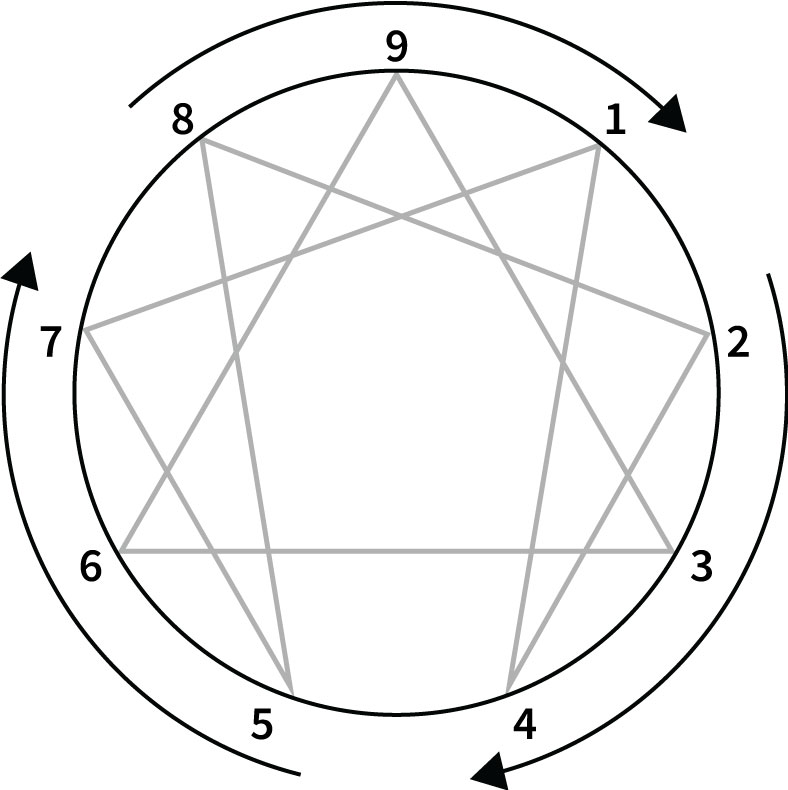
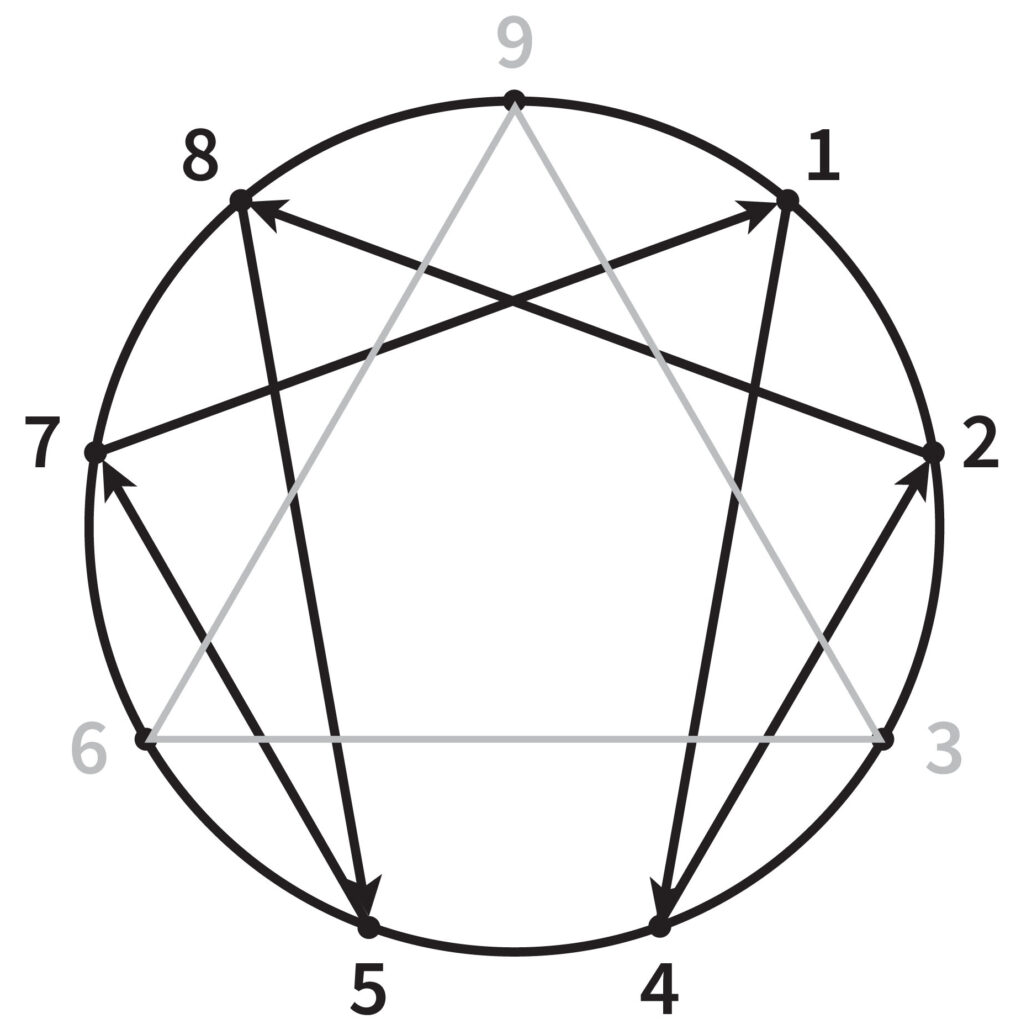
Naranjo was inconclusive regarding arrows on the Enneagram inner lines. Naranjo’s later writings inform us that in exploring the lines and arrows, and his early students misunderstood a point he was making. At the 2005 IEA Conference, O’Leary presented that Naranjo accidentally drew the arrows on a chalkboard to make a point, but it was then perpetuated as truth. Naranjo indicated in earlier writings (1990, 1994) that loss of the ground of being at 9 led to fear at 6 which led to development of a false self (9 to 6 to 3) and later acknowledged the arrows could work in both directions.
Naranjo (2000) apparently developed his chalkboard drawing of mechanical attention following the .142857 from the proceeding sins concept studied by the Desert Fathers (circa 300 CE): Gluttony (7) leads to Lust (8) leads to Greed (5) leads to Anger (1) leads to Melancholy (4) leads to Indolence (9). As for the other 3 points, Vanity (3) led to Pride (2), and Fear was excluded (6). Thus, the proceeding concept was used, but the order was rearranged to .142857.
The first written record we could locate on use of the lines and arrows is in The Enneagram: A Journey of Self-Discovery by Beesing, Nogosek, and O’Leary (1984). It states that Jesuit Tad Dunne presented the arrows in courses between 1971 and 1973, having learned them from Jesuit Bob Ochs, who, in turn, learned them from Naranjo.
The Enneagram arrows drawn on a chalkboard by Naranjo were proposed to present the direction of compulsion or mechanical, automatic attention in the direction of 9 to 6 to 3 to 9 and of 1 to 4 to 2 to 8 to 5 to 7 to 1 (the repeating decimal fraction of .142857). However, as the arrows continue with no completion, it is unclear why a type would move forward to just one number and back to just one number.
Since those early use of the arrows, other theories have been proposed:
- arrows point toward a point we go to in stress (with the arrow) versus security (against the arrow); (Palmer, 1988),
- arrows pointing toward disintegration (with the arrow) versus integration (against the arrow) (Riso and Hudson, 1999), and
- arrows pointing toward the direction of personality development (with the arrow) versus back to our soul child (against the arrow); (Mitri, 2000).
What is clear is that early teachers and students of Naranjo in the 1970s and 80s worked to understand and verify movement of consciousness in the Enneagram symbol (asleep vs. awake). They used and verified through their own experience the dynamics of the symbol.
We realize that many people have since found benefit in how their mechanical and controlled attention can shift. We are highly motivated to discover the objective knowledge of the inner lines and arrows applied to the Enneagram of Personality. (Please contact us if you have this knowledge.)
The Objectivity of a Dynamic, Moving Symbol in the Traditional Enneagram Diagram
“In order to understand the Enneagram it must be thought of as in motion, as moving.
— Gurdjieff quoted by PD Ouspensky, In Search of the Miraculous
A motionless Enneagram is a dead symbol; the living symbol is in motion.”
Now, many years later, the above quote from Gurdjieff is now well understood through the Diatonic Octave. The dynamic, perpetual motion of evolution happens in multiple scales, octaves, blending, oscillations, and shocks.
It is the traditional Enneagram diagram itself that reveals the nature of movement and evolution of consciousness.
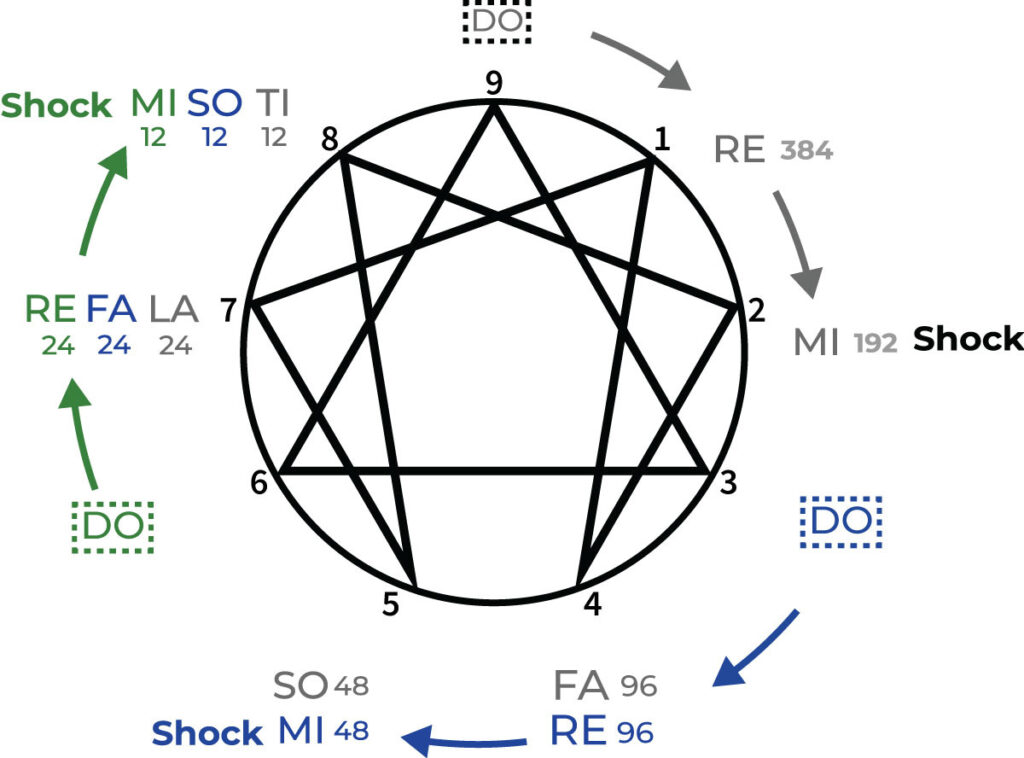
In Part 3, we present the 3 octaves of human consciousness and the potential for movement and change. In Figure 2.14, the dynamic Enneagram symbol reveals movement around the octave and three octaves initiating at 9, 3, and 6.
Briefly, the dynamic movement of 3 octaves includes:
- Octave 1 (black): How we develop from personality to seeking beyond personality
- Octave 2 (blue): How we develop from seeking beyond personality to the rise of a magnetic force within us to find and experience knowledge that is truly objective
- Octave 3 (green): How we develop from a sustained magnetic force to unity consciousness
Figure 2.14 Enneagram Symbol in Motion Within and Between Diatonic Octaves
The Objectivity of An Enneagon of Three Harmony or Valance Triads in Motion
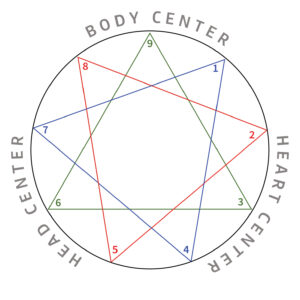
Whereas the traditional Enneagram symbol describes a dynamic evolution of 3 octaves, the Enneagon of three triangles reveals movement between the instincts and centers of our Harmony Triad (Figure 2.15)—what Ichazo calls three valances (the action valance or act for, the reaction valance or act on, and the resulting valance or act with).
Movement can be mechanical—for example, between Point 1, Point 4, and Point 7—but we can also bring our controlled attention to our Harmony Triad to consciously balance our centers. We can examine if we are truly contributing value or whether the movement between points is out of compulsion.
Balancing our Instinctual-Moving, Emotional, and Intellectual energies frees our limited perception and energy, thus providing increased energy and allowing us to receive our life experiences as they are. (We’ll go deeper into this in Part 3).
An embodied practice of our Harmony Triad can help develop a more balanced personality while also leading to seeking what is beyond personality, that is, who we really are.
Figure 2.15 The Harmony Triads
Ichazo: The Trifix of Primary, Secondary, and Tertiary Driving Instinct
Ichazo (2024) labels the enneagon of three triads the trifix, which is where the movement clockwise around the triangle can neutralize the ego fixation we have in the body, heart, and head. Ichazo labels the 3 centers with feelings (rather than sensations), emotions, and thoughts. The Enneagon, rather than the traditional Enneagram is used in Ichazo work.
Through an active and sustained inner witness of our feelings, emotions, and thoughts, we neutralize the fixations and compulsions, freeing essence. A trifix of 8-2-5 (action) or 1-4-7 (reaction) or 9-3-6 (resulting) could be more common, for example, but someone could also have another type from one of the centers (5, rather than 6), such as 9-3-5. (The trifix works similarly to a wing. Most people will fall on the 3 triangles, but others will have a wing-triangle.)
The trifix is closely tied to the instincts. Conservation (self-preservation) with the feeling/body center, Relation (1:1/sexual) with the heart/emotions center, and Adaptation (social) with the head/thoughts center.
| Note: Slicing Into the Enneagram of Personality From Different Locations It is important to note that Ichazo’s work to balance and transcend the trifix is focused on the 3 instincts within the physical, emotional, and intellectual centers. In contrast, Naranjo’s core fixations relate to the three issues of the 3 centers manifested in personality—a separate body in the physical center (separated from unity of the universe), a separate doer in the emotional center, (separated from the universe as the doer), and a separate mind in the intellectual center (separated from the objectivity of the universal mind). Which view is right and which is wrong? There is not a right or wrong between the teaching of Ichazo and Naranjo—it is a matter of both/and. The complexity of the 3-fold division and octaves with interplay of the 3 instincts and the 3 higher being bodies is beyond describing to what Gurdjieff called our Formatory Apparatus (our limited lower intellectual center). The 9 Types are so soundly structured and comprehensively accurate that you can benefit by learning it through the centers, the instincts, or the trifixes. And, of course, what matters most is that one does the work to relax and neutralize the personality fixation. |
Daniels: The Harmony Triads of the Three Centers
Daniels (2010) labels the enneagon of three triads the Harmony Triads with three triangles that he calls the Relationists Triad or acting for others (that is the Red Triangle in Figure 2.16, with a hidden line from 2 to 5 rather than to 4), the Idealists Triad or acting on others (the Blue Triangle with a hidden line from 7 to 4 rather than to 5), and the Pragmatists Triad or acting with others (the Green Triangle).
This version gives each triad access to a Body, Heart, and Head Center and all are on the same valance in relationship to the universe: act for, act on, act with.
Figure 2.16 Three Triads Each with a Body, Heart, and Head Center Point
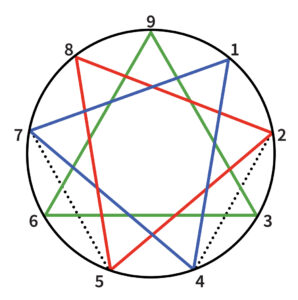
| Legend Figure 2.16 Red Triangle: Act For, bring universe into self, ego acts for the universe — outward, being Blue Triangle: Act On, project self onto universe, ego acts (improves) on the universe — inward, becoming Green Triangle: Act With, aim to balance universe and self, ego act with the universe — outward and inward, being and becoming |
Within the Harmony Triads are 3 additional triads: The Centers, Energy Flow Regulation, and Emotional Regulation. Described below, the triads work together as a system to serve the 3 instincts.
- The Centers Triads
- The Physical Center (9 core) is the seat of our harmony with the world or environment around us. Our natural instincts of agency and empowerment require our physical center to sense both resources and threats in our environment in order to survive, also called a drive for ecological harmony.
- The Physical Center acts on the basis of perceiving what the world and the environment needs. Those living within this world will have confidence when they understand those needs. Their confidence comes from without, from the environment.
- The Emotional Center (3 core) is the seat of emotion. Emotions, particularly the aversive ones, create the desire for action from inside (the self of the me and not-me). Our natural instincts to Bond and Connect require our emotional center to perceive the duality of me and others. To perpetuate the species, it then actively strives to close this gap by connecting with others. Finding a mate, attracting through presentation of status, emotional attunement in bonding, and even fusion with another are all active behaviors to close the gap between the duality of self and others.
- The Emotional Center acts with inner confidence. Those using it have confidence that what they are doing is the right thing at the right time. Their confidence comes from within.
- The Intellectual Center (6 core) is the seat of our cause–effect thinking relying on acquiring data or knowledge of both self and the world or environment to attempt to reconcile them. Our natural instincts of Certainty and Safety require our mental center to specialize in cause and effect thinking to reconcile the gap between the environment and internal state.
- The Intellectual Center acts without confidence but on the basis instead that other paths of action would be wrong (or less right); those using it have confidence in what is least worst. Their confidence comes from compromise.
- The Physical Center (9 core) is the seat of our harmony with the world or environment around us. Our natural instincts of agency and empowerment require our physical center to sense both resources and threats in our environment in order to survive, also called a drive for ecological harmony.
Harmony in the Harmony Triads is further supported by regulation of movement and regulation of emotions in which the remote patterns of 1, 2, 4, 5, 7, 8 link back to the core centers (Figure 2.17).
Figure 2.17 Remote Points Connect to Core Points of 9, 3, and 6 Supporting the Adaptive Behavioral Strategy and Instincts.
Energy Flow Regulation Linking to 9, 3, and 6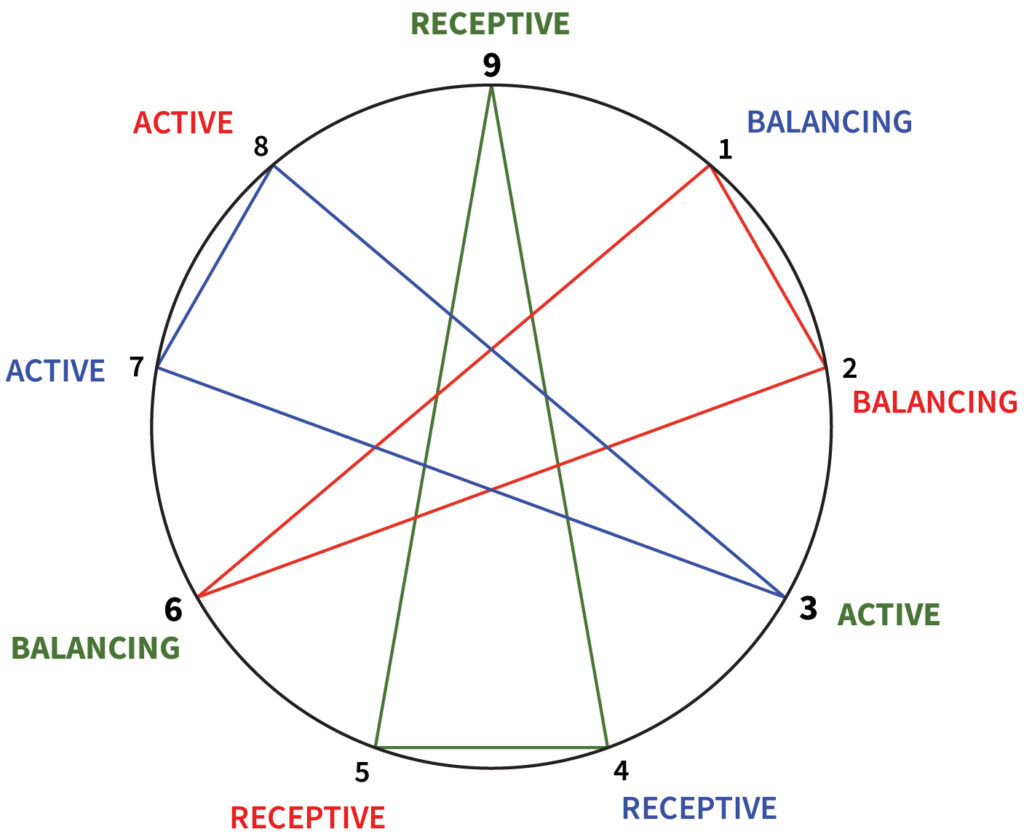 | Emotional Regulation Linking to 9, 3, and 6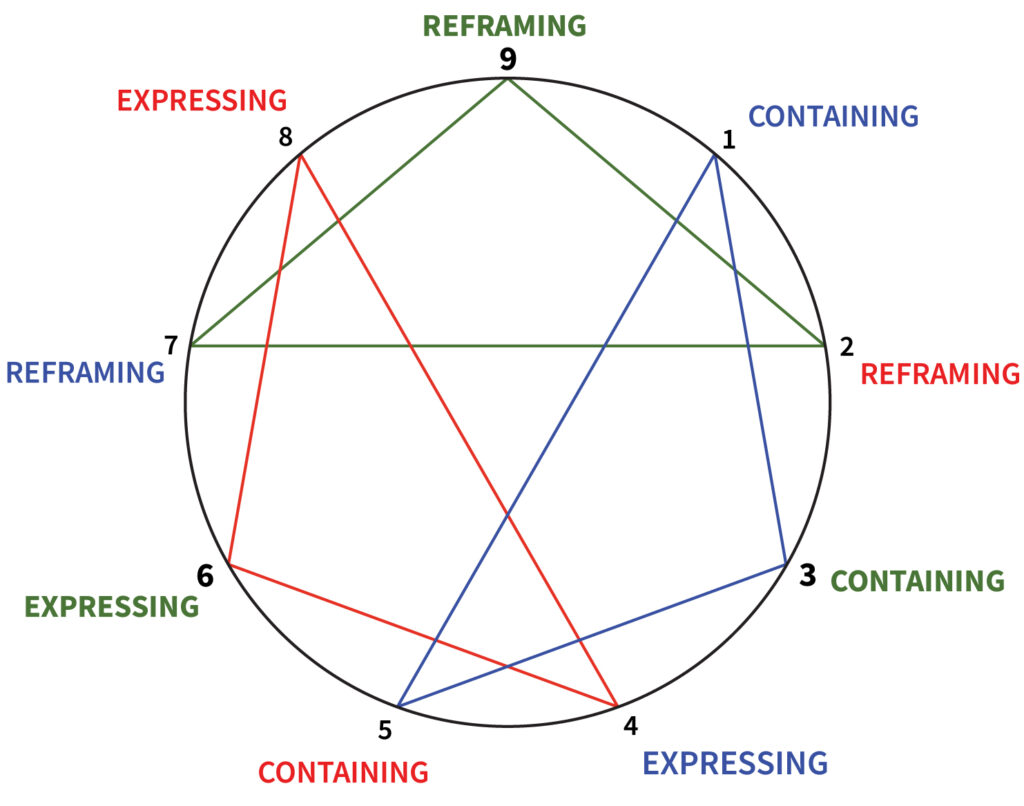 |
The Harmony Triads also reveal 2 additional ways the personality works to cope with separation (see Figure 2.14) and attempt to bring value to others:
- Energy Flow Regulation: When a gap between needs and desires of self and what others or the environment actually delivers forms, the natural flow of movement of the 3 instincts can contract and restrict movement flow.
- Three types (9, 4, and 5) use receptive-physical energy, which can also contract to withdrawing behavior and lead to a loss of empowerment .
- These patterns place their confidence in understanding the needs of the environment. Their confidence comes from outside. Energy of movement flows inward, but can contract to withdrawing or moving away from others.
- Three types (3, 7, and 8) use assertive-emotional energy, which can also contract to aggressive behavior (and loss of connection) .
- These patterns place their confidence in inner abilities to know what to do. Energy of movement flows outward but can contract to aggressive or moving against the energy of others.
- Three types (6, 1, and 2) use balancing-intellectual energy, attempting to reconcile internal and external states, which can also contract to compliant or dependent behavior and relinquish internal certainty to others.
- These patterns place their confidence in others or in a compromised confidence. Energy of movement balances or moves toward but can contract to comply the demands of others and the environment.
- This underlying flow of movement is demonstrated in object-relations, describing a young child’s movement away from, against, or toward others. It also arises in numerous other relationships and situations where the I and object on the outside are or are not resonating.
- The mind, with all 3 centers working together, has the ability to produce a regulated movement response leading the energy of the instincts along a more natural free flowing path where self and the other resonate and uses:
- receptive and present energy,
- active and grounded energy, and
- balanced energy which takes in self and the other.
- Three types (9, 4, and 5) use receptive-physical energy, which can also contract to withdrawing behavior and lead to a loss of empowerment .
- Emotional Regulation: When a gap between needs and desires of self and what the environment actually delivers in an everyday interpersonal issue, a longer-standing conflict, or in a traumatic event leads to the rise of aversive emotions. This leads to action to close the gap between me and not-me.
- Three types (9, 2, and 7) have a bias in the physical center to restore harmony with the environment. To solve problems and conflict, they reframe when aversive emotion is combined with their instinct for agency or resistance, repressing their emotions while reframing the environment as positive and harmonious.
- Three types (3, 1, and 5) have a bias in the emotional center to take assert self in response to feelings, to do, and to accomplish. They contain when aversive emotion is combined with their instinct for bonding, suppressing their emotions to maintain connection with others while taking time to reason and build rationale to solve problems and conflict .
- Three types (6, 4, and 8) have a bias in the intellectual center to reconcile the gap between me and not-me with intellectual knowledge. We express when aversive emotion is combined with our instinct to master the environment and achieve successful resolution, amplifying our emotions to uncover data and knowledge about the root cause of problems .
- A spectrum of emotionally regulated behaviors are demonstrated in everyday interpersonal ruptures, more serious events requiring conflict resolution, and in trauma where the gap between I and what the environment delivers is very wide.
- With conscious awareness, the mind, with all 3 centers working together, has the ability, to produce a regulated emotional reaction leading to:
- shifting emotions without completely repressing them,
- down-regulating emotions so they are contained and present rather than suppressed, and
- up-regulating emotions enough so they are experienced for constructive expression and verbalization to uncover what’s really going on and increase knowledge.
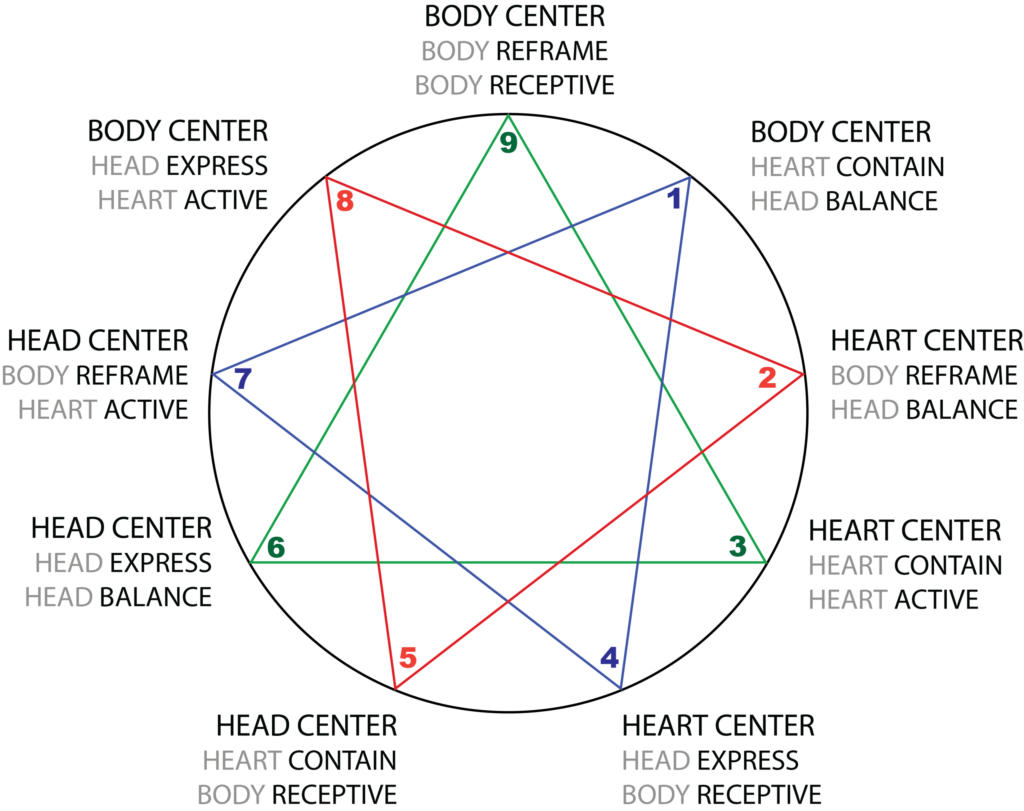
A careful study of the Harmony Triads in the work of Dr. David Daniels reveals why 3 equilateral triangles within the Enneagram circle represent the developmental pathway from 3 centers—which evolved to serve the 3 instincts—to 9 patterns. The Harmony Triads contain our fundamental relationship with the world: act for, act on, or act with. From a biological standpoint, all of the universe is a self-regulating machine. David Daniels’ labeling of the Harmony Triads reflects this basic self-regulating process of adaptive behavioral strategies.
Together Figure 2.18 reveals that the three core points ultimately achieve balance working between 3-6-9, whereas the remote points use all three centers and also balance between 2-5-8 and between 4-7-1.
Figure 2.18 The Harmony Triads–Each Center’s Core Point ACTS WITH (Green), Each Side of the Core Center is an ACT FOR (Red) and ACT ON (Blue)
| Note: Contributors to the Enneagram Harmony Triads (20th Century) Although David Daniels, M.D. can be credited with linking all triads and the 3 centers in the microcosm of the Harmony Triads, the parts that make up the whole of the harmony include work of Ichazo, A.H. Almaas, Tad Dunne, Ph.D., Don Riso and Russ Hudson, Bill Schaefer, Ph.D. , and Gurdjieff scholar Steven Wheeler. Early studies by Bob Ochs, Tad Dunne, and other Jesuits explored the bounds of the possible patterns of 3-foldness within the Enneagram diagram. From 1971 to 1974, Tad Dunne taught two of the triads, including this fundamental relationship to the world and a child’s object relations to Beesing, Nogosek, O’Leary, Hurley, Dobson, and Riso. The third triad (conflict resolution) was likely identified by Riso and Hudson. A.H. Almaas further identified the actions of the 3 equilateral triangles (Almaas, 2000, with a preface by Ichazo). In 2008, Bill Schafer, a colleague of David Daniels, provided additional clues to the mathematical structure of the enneagon (Schafer, 2008). In 2008 to 2010, Daniels pieced the parts together and appropriately named them the Harmony Triads. Of course, this math and knowledge has been known in times past, but these contributors have made it known in the 20th Century. |
In Part 3, we will describe using the Harmony Triads in a conscious motion to free our limited lens and free our compulsive, habitual behaviors. And, for those interested in the mathematical 3-fold fractal pattern of the Enneagram Harmony Triads, this following sections provides an explanation.
Mathematical Patterns of the Harmony Triads
We first develop a reliance on one of the 3 Centers of Intelligence, in which our personality initiates from one of the centers.
- Body (9), initiates by receiving outer
- Heart (3), initiates by inner feelings
- Head (6), initiates by attempting to reconcile outer and inner
But the Law of 3 also predicts six mixed or “wing” patterns that are possible from 3 “core” patterns, with a reliance starting with the center, then emotional regulation, followed by energy regulation. These patterns are well-described in Riso and Hudson (2000) but miss the operation of initiating, passing a denying force, and attempts for reconciliation.
- Body 1st, Heart 2nd, Head 3rd — Pattern 1
- Body 1st, Head 2nd, Heart 3rd — Pattern 8
- Heart 1st, Head 2nd, Body 3rd — Pattern 4
- Heart 1st, Body 2nd, Head 3rd — Pattern 2
- Head 1st, Body 2nd, Heart 3rd — Pattern 7
- Head 1st, Heart 2nd, Body 3rd — Pattern 5
The three forces in the Law of 3 – initiating (+), denying (-), and reconciling (=) indicate the likely order of reliance, but they also happen in varying sequences and/or simultaneously. The dominant Center of Intelligence Initiates, Emotional Regulation attempts to reconcile or supports, and Energy Regulation is used to pass the denying force or protects.
- Body 1st (+), Heart 2nd (=), Head 3rd (-) — Pattern 1
- Body 1st (+), Head 2nd (=), Heart 3rd (-) — Pattern 8
- Heart 1st (+), Head 2nd (=), Body 3rd (-) — Pattern 4
- Heart 1st (+), Body 2nd (=), Head 3rd (-) — Pattern 2
- Head 1st (+), Body 2nd (=), Heart 3rd (-) — Pattern 7
- Head 1st (+), Heart 2nd (=), Body 3rd (-) — Pattern 5
The pattern that Ichazo identified has correspondence with Daoism. Although Daoism treats Yang as affirming, it does not treat Yin as denying; rather, it treats Yin as ‘receiving’. A more accurate reflection is to associate Yang/Heaven with the top DO and Yin/Earth with the bottom DO: i.e. they are ‘poles’ rather than forces. Then Human is the oscillation FA-SO-LA, if not the whole octave between the DO’s.
| Law of 3 | Force 1 (+) | Force 2 (-) | Force 3 (=) |
|---|---|---|---|
| Ichazo | Action | Reaction | Return |
| Daoism | Earth, inner world is Yin, to which the outer world is Yang. Receiving | Heaven, inner world is Yang, to which the outer world is Yin. Affirming, asserting | Human, inner world is part Yin and part Yang, on a journey to a result (only Human between Heaven and Earth). Receiving and asserting |
The Three Survival Instincts and the Science of Patterns
In a circle with 9 equidistant points, 3 equilateral triangles are possible and display where “mathematical strange attractors” land (see Figure 2.18). As stated earlier, we start with the green triangle representing the 3 forces in the Law of 3. We also have the 3 reliances placed at each of the 9 points: The 3 Centers of Intelligence Triads, the 3 Emotional Regulation Triads, and the 3 Energy Flow Regulation Triads.
The 3 survival instincts studied in the “ancient” science of patterns, create a very simple 3-fold fractal pattern. One of the most well-known science of patterns can be found in Daoism which also aligns with the Enneagram’s 3-fold fractal pattern.
This 3-fold pattern continues to fracture creating complex instances of human behavior.
Figure 2.19: Fractal Pattern Emerges from 3 Survival Instincts
| From 3 Centers and Motivational Vectors to 9 Patterns | The 3 Instincts | Enneagram’s Science of Patterns Primary Function of the 3 Centers of Intelligence | Daoism Science of Patterns |
| Patterns 8-5-2 | Survival of the body Outward attention and action, then turn inward (act-sense-assess) | Body Center Receive the environment through senses and movement | Earth Triad, Yin, energy flows from outward to inward. Inner world is Yin, to which the outer world is Yang. |
| Patterns 1-4-7 | Connect with our species Inward attention and internal action, then assert outward (sense-act-assess) | Heart Center Assert self in response to inner feelings | Heaven Triad, Yang, energy flows from inward to outward. Inner world is Yang, to which the outer world is Yin. From this, you could say they are Heaven types. |
| Patterns 9-3-6 | Adapt to and make the environment more amenable Dyadic balance between outer and inner (act-sense-assess) | Head Center Attempt to reconcile environment with inner state, discerning cause and effect | Human Triad Yin/Yang, energy attempting to balance. Their inner world is part Yin and part Yang, on a journey to a result that serves their adopted aim. From this you could say they are only Human (between Heaven and Earth). |
This final Figure 2.20 can be studied to learn the nuances of how the 3-fold fractal pattern works in the 3 core patterns and the 6 wing patterns. The 3 Centers of Intelligence and the 3 triads that regulate behavior, emotion, and energy, indicate that attention changes direction based on different forms of regulation.
Figure 2.20: The Evolution of the 3 Instincts and All Triads in the Enneagram Harmony Triads
| 1st survival instinct to evolve (outward bias) | 2nd survival instinct to evolve (inward bias) | 3rd survival instinct to evolve (dyadic bias) | |
| Instincts, Gurdjieff | Survival of the soma | Connect with species | Master the environment and make it more amenable |
| Instincts, Ichazo | Conservation | Syntony, Relational | Social, Adaptation |
| Instincts, Naranjo | Self-Preservation | One-on-One | Social |
| Center’s Dominant Instinct | The self-preservation instinct | The one-on-one instinct | The social instinct |
| Centers of Function, Evolutionary Purpose | Body or Instinctual-Moving Center Evolved to optimize the instinct of survival, its key function is to receive the environment through senses and movement. | Heart or Emotional Center Evolved to serve the instinct to connect with our species, its key function is to assert self through emotions. | Head or Intellectual Center Evolved to serve the instinct to adapt to the environment, its key function is to reconcile gaps between what the environment delivers and the internal state. |
| Center’s Dominant Filtering and Memory Associations | The world is filtered through the five senses and kinesthetic or moving-boundary intelligence. | The world is filtered through internal feeling states and intuition. | The world is filtered through the mental faculties and forming associations between cause and effect. |
| Center’s Dominant Motivation | The self-preservation instinct of the body creates the need for Agency and Empowerment. Intent is outward toward harmony of the environment (optimized resources, minimized threat). | The one-on-one instinct between self and other creates the need for Bonding and Connection. Intent is inward to experience of syntony in relationships. | The adaptation-social instinct creates the need for Certainty and Safety. Intent is knowledge in dyadic form to reconcile outer and inner states and understanding of cause and effect. |
| The Center Triads Reflect Initiating (Note: Not every single response, but the habitual result.) | Initiating with Outward Attention, Patterns 9, 8, 1 | Initiating with Inward Attention, Patterns 3, 2, 4 | Initiating with Dyadic Attention, Patterns 6, 5, 7 |
| Center’s Bias in Attention | Attention outward to environment, builds confidence by understanding the needs of the environment. | Attention inward to feeling states, builds confidence by relying on inner abilities to know what to do. | Attention dyadic attempts to reconcile the environment and internal feelings, builds confidence in attempting to gain knowledge on cause and effect. |
| The Action Regulation Triads Reflect All Centers Working Together (Note: All action reflects all centers working together.) | Head Acts Outward, Body Receives, Heart Assess Emotions of Inclusion or Rejection by Others, Patterns 8, 2, 5 | Body Resists, Head Acts Inward, Heart Assess Emotions of Satisfaction or Frustration, Pattern 1, 4, 7 | Head Acts Dyadic, Body Receives and Resists, Heart Assesses Emotions of “Non-Separation” or Separation, Patterns 9, 3, 6 |
| Monitoring Function of Mind Changes Direction of Attention and Action/Behavior — For All Types | Outward Act For receives the environment as it is and turns outward to act for others | Inward Act On resists the environment and turns inward to inner idealization and improves on others | Dyadic Act With, turns outward and inward, balancing energy, dyadic attention, energy, action |
| The Emotional Regulation Triads Reflect Reconciling or Supporting the Initiating Center | Body Center Attempts to Reconcile, Outward Shifting and Reframing of Environment, Patterns 9, 2, 7 | Heart Center Attempts to Reconcile, Inward Containing and Analyzing while Preserving Bonding, Patterns 3, 1, 5 | Head Center Attempts to Reconcile, Dyadic Expressing and Voicing of Cause and Effect Knowledge, Patterns 6, 4, 8 |
| Emotional Regulation Modification Function of Mind Changes Direction of Attention — for wings, not 3, 6, 9 | Emotions in the Body Center regulated by shifting so that attention remains outward on receiving the environment and harmony of environment can be discerned. | Emotions in the Heart Center regulated by containing emotions in a “wait” with attention focused on inner state knowing what to do. | Emotions in the Head Center regulated by expressing internal emotions to other/environment as a dyadic discernment of knowledge and root cause internal/self or external/other. |
| The Energy Regulation Triads Reflect Passing the Denying Force (Building Confidence to Act) A Protecting Regulation | Body Center Places Confidence in the Environment to Pass Denying, Energy Flows Outward to Inward, Patterns 9, 4, 5 | Heart Center Places Confidence in Inner Ability to Pass Denying, Energy Flows Inward to Outward, Patterns 3, 7, 8 | Head Center Places Confidence in Compromise to Pass Denying, Energy Flows Between Inward and Outward, Dyadic, Patterns 6, 1, 2 |
| Energy Regulation Modulation Function of Mind Changes Direction of Attention — for wings, not 3, 6, 9 | Energy flow is regulated outward to inward, receives the environment through senses and movement, then energy moves in and down to conserve and protect, to “wait and see” | Energy flow is regulated inward to outward, asserts self through emotion, energy moves up and out toward result, to “go out there and try” | Energy flow is regulated inward and outward, balancing between self and other/environment, energy moves to balance of needs of self and other/environment |
Part 2 Summary: The Objective Enneagram Reveals Wholeness in 7, 3, and 9
In Part 2, we set out to answer three clusters of questions from the perspective of objective science as summarized here.
(1) How does wholeness in 7 in the Diatonic Octave lead to 7 centers in the human body? Through billions of years of evolution, starting with an Initiating of Life at DO and a Completing of Unity Consciousness at DO, 7 centers evolved. •2 Centers do not require learning The Sexual or Reproductive Center (pure memory of DNA) The Instinctual Center (automatic, involuntary) •3 Lower Centers Named Lower to Represent the Memory of Conditioned Learning The Instinctual-Moving Center (an oscillation in the octave links to the instinctual and moving centers) The Lower Emotional Center The Lower Intellectual Center •2 Higher Centers (released from conditioned learning) The Higher Emotional Center (presence, impartiality, and capacity for we/us/ours) The Higher Mental Center (understanding and capacity for objective reasoning from the universe itself) (2) How do we get to 3, 9, and 27 personality types? Why are head, heart, and body types grouped where they are around the circle? And why is 9 at the top? Objectively, the universe initiates with DO at point 9, denying at FA, point 3, and reconciling at LA, point 6. This places 9 at the top, at DO. Although the force labels rotate in the subjective ego position, objectively, 9 remains at the top. • Universe: Sensing, Body Center is at 9 (initiating), first detecting me and not-me — Ego: Body Center at 9 rotates to reconciling by storing new learned associations between me and not-me • Universe: Feelings, Emotional Center is at 3 (denying) — Ego: Emotional Center denies the universe, then initiates from I •Universe: Mind/will, Intellectual Center is at 6 (reconciling) — Ego: Intellectual Center attempts to close the gap of me and not-me, then failing in a subjective world it becomes the denying force Why 9, and why those 9? Unity separates into 3 forces that align with and create reliance on the 3 centers, then 3 relationships to the world emerge (act for, act on, act with), then 3 more for conditioned instincts (SP, SX, SO) (3) Why use the Enneagram symbol, a process model of lower and higher, when all 9 types are equal? Why the lines and arrows? The traditional Enneagram symbol reveals motion and change, where there are 7 inner principles of the diatonic octave with 2 shocks potentiating 2 more octaves of development, including all 3 higher being bodies The Harmony triads are revealed objectively as the three most fundamental relationships between me and not-me in an Enneagon also with implications for movement of consciousness Although we did not identify objective science of the inner lines and arrows, we are continuing to seek that knowledge. Please contact us if you have information. |
In Part 3, we will provide a basic outline of how the Enneagram of Personality serves as a ground of being for all of psychology, highlighting key concepts on helping and healing.
- The basic idea of adding consciousness (controlled attention through the inner witness) to Western psychology coping mechanisms which takes us past treating symptoms to working with the root of suffering.
- A glossary of terms helpful to the helping and healing professions.
- Key objective and lawful practices for well-being including: The Remedy of the Holy Ideas, The Harmony Triads, The 5 A’s, and The 3 Octaves of the Evolution of Consciousness.