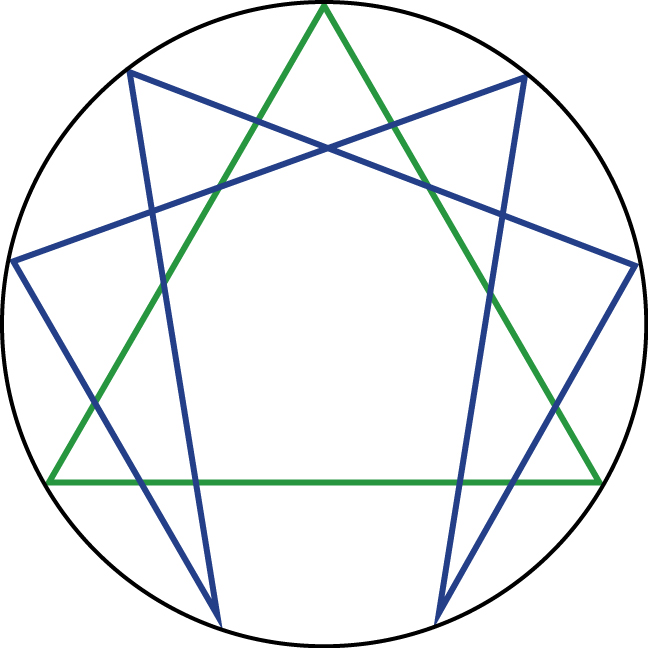
Preserving Objective Enneagram Science and Knowledge
The Objective Enneagram Project was initiated by Denise Daniels and Steven Wheeler in January 2025. If you are interested in joining them to document objective knowledge about the Enneagram and the Enneagram of Personality, reach out using Contact Us, then they will set up a Zoom call.
Our intent is to bring attention to the Enneagram as on objective data science of patterns of consciousness.
| The authors are especially interested in hearing from you if: • You have studied objective science stemming from the natural laws of 3, 7, and other natural laws communicated by Gurdjieff and Ichazo • You have knowledge to disprove or challenge the content in this project |
It is the authors’ intent for the Objective Enneagram Project to serve as a living document so that future generations have a summary of the objective knowledge contained in the Enneagram.
Project Summary
The 20th century reintroduced the Enneagram symbol to the world:
- The laws of the universe and process through G.I. Gurdjieff
- The nature or content of consciousness through Oscar Ichazo (then personality through Claudio Naranjo)
Let’s align with original sources and Gurdjieff advancements. The Enneagram of Personality has spread quickly around the world primarily because people find themselves in 1 of the 9 types, rapidly see their auto-pilot personality, and verify that practices to balance and relax their personality leads to a better life for self and for understanding others.
In contrast, the work of Gurdjieff has had a slower rise because of the complexity thereof and decoding needed to decipher his writings. Until Russell Smith decoded the laws of creation and maintenance known by the ancients, the Law of 7 only revealed a few simpleton processes and did not align with life’s diatonic octave. Although the Laws of 3 and 7 are simple, the decoding by Smith, first published in 1993 now provided the precise mathematical structure of the building blocks of the universe, along with the diatonic structure of consciousness significant to modern psychology.
Ichazo, steeped in western philosophy and direct inner knowing, articulated the 9 ego fixations and 27 instinctual subtypes as part of a larger system of universal unity.
Next, Naranjo served as the translator between these esoteric foundations and contemporary psychology, introducing the term for the entire system and structure of personality as the Enneagram of Personality in 1971 with a leaning toward understanding psychopathology.
Let’s keep alive the Objective Enneagram of Personality. In Part 2, we made it our goal to codify the Enneagram’s mathematical and physical structure, describing wholeness in 9, 7, and 3.
Wholeness in 7 explains how consciousness evolves through 7 centers—Reproductive, Instinctual, Lower Instinctual-Moving, Lower Emotional, Lower Intellectual, Higher Emotional, and Higher Mental. These correspond to evolutionary stages observable across all life forms.
The Enneagram of Process thus describes both the physical process of evolution and the development of consciousness from automatic and mechanical attention to controlled attention that embodies presence of internal and external awareness, and then to the capacity for objective consciousness.
Wholeness in 9, or the Enneagram of Personality, points to the dynamic motion of 3 octaves of human development.
Wholeness in 3 describes the 3-fold fractal pattern forming personality which starts the same way in all of us. We experience separation after birth, where experience deviates from our 3 natural instincts. But each of us learns to cope and bring value in different ways.
From unity we develop dominance in one of 3 centers, then one of 9 fundamental actions to close the gap between me and not-me, then one of 27 distorted instincts. This unfolding of 27 personality types is based on physical laws related to inner state, external environment, value to self and others, and 3 life affirming instincts.
The inner lines and arrows of the Enneagram have been verified by many to inform how compulsive autopilot attention can be disrupted, but to-date we have not discerned objective knowledge on the inner lines. We are highly motivated to identify the objective, so please write to us.
Let’s All-Remember that “Our Inner Witness” and “Doing the Work” is What’s Most Important. In Part 3, we skimmed the surface of indigenous, ancient concepts of relieving suffering and how the Enneagram is a supplement and fundamental foundation for all psychology.
The Enneagram can be understood with an awakened witness consciousness. Without that, we type ourselves based on our outside characteristics or our idealized self image rather than our internal consciousness. Enneagram tests and typing, methods to balance the personality, and motivation to seek what is beyond personality all require that we have an active recognition of watching our sensations, feelings, and thoughts while being present to them.
When most people attempt to remain present, they find that controlled attention slips in the first 30 seconds, but with practice, many people have verified they can sustain controlled attention.
Here, paying attention to our “inner witness” and doing “The Work” is what’s most important.
Ancient systems of helping were grounded in consciousness as the cure and in the restoration of essence rather than the management of symptoms. The Enneagram offers practices such as self-remembering, balancing our 3 lower centers, building presence within our Harmony Triad, receiving self and others as we are, and integrating our capacities of essence.
These methods along with progressing through our 3 octaves of human consciousness are not merely therapeutic but correspond to objective lawful processes of relieving our suffering and inner evolution. Gurdjieff and Ichazo both knew that realizing our consciousness is possible for everyone.
| What Remains to Be Done in the Short Term We encourage you to verify the objective knowledge in this article with the sources we have provided. (For more resources, see Sources, Notes, and Resources below.) We are interested in your objective knowledge, whether to disproof, for verification, or to supplement our findings. We continue to seek objective knowledge on the inner lines and arrows of the Enneagram symbol. If you have insights you would like to share, contact us to set up a Zoom call. You can also reach out to Steven directly at stevewlrls@gmail.com. |
| What Remains to be Done Now and for Generations to Come To continue to integrate objective science, human development, and embodied methods for the development of our consciousness, future work—when accomplished with our witness consciousness—will be key to advancing objective science. To continue to preserve, verify within ourselves, and responsibly transmit this objective knowledge, future work must ensure that the Enneagram remains free from distortion, reduction, personal conditioned lens, or cultural subjectivity. |
About the Authors and Acknowledgements
About Denise Daniels: Developmental Psychologist, Objective Enneagram of Personality Scholar
Denise Daniels is a retired Silicon Valley startup executive and social scientist who is now devoted to the scholarship and practice of objective knowledge. Since her introduction to the Enneagram through her father, David N. Daniels, M.D. in 1984, she has always been interested in how the 9 patterns of personality or subjective consciousness came to be. As a young social scientist, she immediately recognized the 9 patterns as part of the universe itself, as part of the cosmic laws that created the universe, as part of objective reality. Denise has studied the Enneagram of Personality since 1984, and the Objective Enneagram of Personality and the development of consciousness revealed in octaves of the Law of 3 and 7 since 2024.
In Denise’s words, “the Enneagram of Personality is not theory, it is a scientific discovery revealing 9 naturally occurring patterns, which have specificity, preciseness, and connectedness that could not be discerned by ordinary knowledge. All that being said, my father often communicated to me ‘what really matters is doing the work to develop your consciousness,’ and he devoted his life work to helping as many people as he touched do that.”
Denise’s Acknowledgements
I would like to acknowledge the people who have made this article possible.
First, my father, David N. Daniels (1934 to 2017) a founding father of the modern Enneagram of Personality. His courage to embrace the Enneagram, bridge mainstream science, and bring credibility to the Enneagram has inspired me and many others.
Second, is Beatrice Chestnut, an Enneagram of Personality scholar who in 2023 encouraged me to carry forward the Objective Enneagram.
Third, is Steven Wheeler, a Gurdjieff and Objective Science scholar, who is an author on this article. This article would not be possible without him. Steven devoted many hours of his time so that I could understand objective science and the mathematical-physical structure of the Enneagram of Personality.
Also, Russ Hudson distinctly and clearly articulated that I explore the 3-fold unfolding nature of the Enneagram and to “keep looking for the repeating pattern of self, object, and the field of relation between them.”
Finally, I’d like to thank Bob King, a Gurdjieff scholar who has spent a great deal of his time deciphering why Gurdjieff mentions 27 personality types, has 9 meetings with remarkable men, and how it aligns with Ichazo’s work.
About Steven Wheeler: Mathematician, Gurdjieff and Objective Science Scholar
Steven Wheeler is a retired IT executive who is now devoted to the scholarship and practice of the objective universe and objective consciousness.
Steven’s Acknowledgements
John Perrott was my direct teacher in Fourth Way practice and objective science. He in turn studied with J.G. Bennet at Combe Springs and later with Russell Smith in Sanger, Texas. I also studied with Russell Smith, going through his book Gurdjieff: Cosmic Secrets and his April Fool exercise to awaken the Observer Conscious State.
| Thank you to our Reviewers Robin Bloor, Gurdjieff Scholar, reviewed November 2025 Steven Aronson, Gurdjieff Scholar, reviewed December 2025 Gary Eggleton, Gurdjieff and Smith Scholar, reviewed March 2026 |
Sources, Resources, and References
Sources Used for Objective Science from Gurdjieff, Ichazo, and Naranjo
| Gurdjieff Sources Gurdjieff, Georges I. Chapter 30: Art. Beelzebub’s Tales to His Grandson: An Objectively Impartial Criticism of the Life of Man. Hartcourt, 1950. All and Everything First Series, Arkana, 1999. 449-523. Gurdjieff, Georges I. Meetings with Remarkable Men. Routledge, 1963. All and Everything Second Series, Arkana, 1991. Gurdjieff, Georges I. Life Is Real Only Then, When “I Am.” Dutton, 1981. All and Everything Third Series, Arkana, 1999. Gurdjieff Secondary Sources Ouspenski, Peter. D. In Search of the Miraculous: Fragments of an Unknown Teaching. Harcourt, 1949. Ouspenskij, Peter. D. The Psychology of Man’s Possible Evolution (1933 Lectures). 2. ed., Vintage Books, 1974, 1. ed., 1950 Hedgehog Press. Smith, Russell A. Gurdjieff, Cosmic Secrets. TheDog, 1993. Wheeler, Steven. Notes from a Small Village, https://stevenwheelerblog.wordpress.com/ 2020-2026. Ichazo Sources Ichazo, Oscar. Breaking the Tyranny of the Ego: Interview by Sam Keen, 1973. Interviews with Oscar Ichazo. 1st ed., Arica Institute Press, 1982, 3-24. Ichazo, Oscar. Lecture The Collegiate College London, 1981. Between Metaphysics and Protoanalysis: A Theory for Analyzing the Human Psyche. 1st ed., Arica Institute Press, 1982, 69-88. Ichazo, Oscar. Oscar Ichazo Breaks his Silence About a Powerful Nine-Pointed Symbol and the Battle to Control It: Interview by Michael Goldberg. Metro Santa Clara’s Weekly Newspaper, November 1993, 14-21. Ichazo, Oscar. The Enneagrams of Divine Forms. The Oscar Ichazo Foundation, 2024. Ichazo Secondary Source Lilly, John. and Hart, Joseph. The Arica Training (1970). Transpersonal Psychologies. Tart, Charles (Ed.) Psychological Processes, 1975. Medina, Brandon. The Enneagram – A History (Part 3). Theology Think Tank. https://theologythinktank.com/the-enneagram-a-history-part-3/ , 2019. Naranjo Sources Naranjo, Claudio. Ennea-Type Structures: Self-Analysis for the Seeker. Gateways/IDHHB Inc., 1990. Naranjo, Claudio. The Psychology of Enneatypes as a Catalyst for Change in Education and Society. International Enneagram Association Keynote Address, 2003. Naranjo, Claudio. The Enneagram of Society: Healing the Soul to Heal the World. Gateways Books and Tapes, 2004. |
Sources for Learning the Enneagram of Personality and How it is Used in Helping, Healing, and Human Potential
| Resources for Learning About the Enneagram of Personality Almaas, A.-Hameed. Essence: The Diamond Approach to Inner Realization. Nachdr., Weiser, 1995. Almaas, A. H. Facets of Unity: The Enneagram of Holy Ideas. Shambhala, 2000. Chestnut, Beatrice. The Complete Enneagram: 27 Paths to Greater Self-Knowledge. She Writes Press, 2013. Daniels, David, Price, Virginia. The Essential Enneagram: The Definitive Personality Test and Self-Discovery Guide — Revised and Updated. With Virginia Price, Harper Collins Publishers, 2000, 2009, 2025. Daniels, David, Dion, Suzanne. The Enneagram, Relationships, and Intimacy: Understanding One Another Leads to Loving Better and Living More Fully. Foreword Daniel J. Siegel, 1st ed, Morgan James Publishing, 2018, 2024. Maitri, Sandra. The Enneagram of Passions and Virtues: Finding the Way Home. Penguin Publishing Group, 2005. Palmer, Helen. The Enneagram: Understanding Yourself and the Others in Your Life. 1. ed, Harper & Row, 1988. Riso, Don Richard, and Russ Hudson. The Wisdom of the Enneagram: The Complete Guide to Psychological and Spiritual Growth for the Nine Personality Types. Bantam Books, 1999. Schafer, William M. Roaming Free inside the Cage: A Daoist Approach to the Enneagram and Spiritual Transformation. iUniverse rev. date: 12/22/09, iUniverse, 2009. |
References Cited About Inner Lines, Arrows, and Harmony Triads in The Objective Enneagram Project
| Reference Citations on The Enneagram’s Inner Lines and Arrows Gurdjieff Students Bennett, John G. Enneagram Studies. Weiser, 1974. Collin, Rodney. The Theory of Celestial Influence: Man, the Universe, and Cosmic Mystery. Mercury Publications ed., Mercury Publications, 1954. Nicoll, Maurice. Psychological Commentaries on the Teaching of Gurdjieff and Ouspensky: Vol. 2 Eureka Editions, 1952. Reference Citations on The Enneagram of Personality’s Inner Lines and Arrows Harmony Triads Almaas, A. H. Facets of Unity: The Enneagram of Holy Ideas. Shambhala, 2000. Daniels, David. The Enneagram’s Harmony Triads. International Enneagram Association Presentation, 2010. Daniels, David. The Harmony Triads. https://drdaviddaniels.com/the-enneagram-triads/ 2014-2026. Dunne, Tad. Enneatypes, Method & Spirit: Our Nine Basic Compulsions. Universal Publishers/uPUBLISH.com, 1999. Ichazo, Oscar. The Enneagram of Divine Forms. The Oscar Ichazo Foundation, 2024. O’Leary, Patrick. The Enneagram Arrows. International Enneagram Conference Presentation, 2005. Riso, Don. Personality Types. HarperOne, 1987. Riso, Don and Russ Hudson. Understanding the Enneagram: The Practical Guide to Personality Types. Rev. ed, Houghton Mifflin, 2000. Schafer, William M. Roaming Free inside the Cage: A Daoist Approach to the Enneagram and Spiritual Transformation. iUniverse rev. date: 12/22/09, iUniverse, 2009. Reference Citations on The Enneagram of Personality’s Inner Lines and Arrows Naranjo/Ochs Students Beesing, Maria, Nogosek, Robert, and O’Leary, Patrick. The Enneagram: A Journey of Self-Discovery. Dimension Books, 1984. Hurley, Kathleen V., and Theodore E. Dobson. What’s My Type? Use the Enneagram System of Nine Personality Types to Discover Your Best Self. 1. ed, Harper, 1992. Maitri, Sandra. The Spiritual Dimension of the Enneagram: Nine Faces of the Soul. Jeremy P. Tarcher/Putnam, 2000. Naranjo, Claudio. Ennea-Type Structures: Self-Analysis for the Seeker. Gateways/IDHHB Inc., 1990. Palmer, Helen. The Enneagram: Understanding Yourself and the Others in Your Life. 1. ed, Harper & Row, 1988. Riso, Don Richard, and Russ Hudson. The Wisdom of the Enneagram: The Complete Guide to Psychological and Spiritual Growth for the Nine Personality Types. Bantam Books, 1999. Riso, Don Richard, and Russ Hudson. Understanding the Enneagram: The Practical Guide to Personality Types. Rev. ed, Houghton Mifflin, 2000. Smith, Russell, A. The Blueprint of Consciousness. TheDog, 2021. |
Images Used by Permission Wikimedia
| Images by Permission Wikimedia License Giles, Laurent, Sun Setting in the Namib Desert https://commons.wikimedia.org/wiki/File:084_Sun_setting_in_the_Namib_desert_Photo_by_Giles_Laurent.jpg MistyEyedKid, Yosemite Falls Seen Through the Trees During Sunrise https://commons.wikimedia.org/wiki/File:Yosemite_falls_seen_through_the_trees_during_sunrise.jpg Mansari007, Hindu Kush Range https://commons.wikimedia.org/wiki/File:Hindu_Kush_Range.jpg Foreverascone, Periodic Table of Elements https://commons.wikimedia.org/wiki/File:Subshells_of_Orbitals.jpg Note: All other images are in Wikimedia Open Domain or created by the authors. |


